Self-awareness sounds simple, right?
Be aware of your strengths, weaknesses, and triggers. Easy enough.
But wait until you hear this.
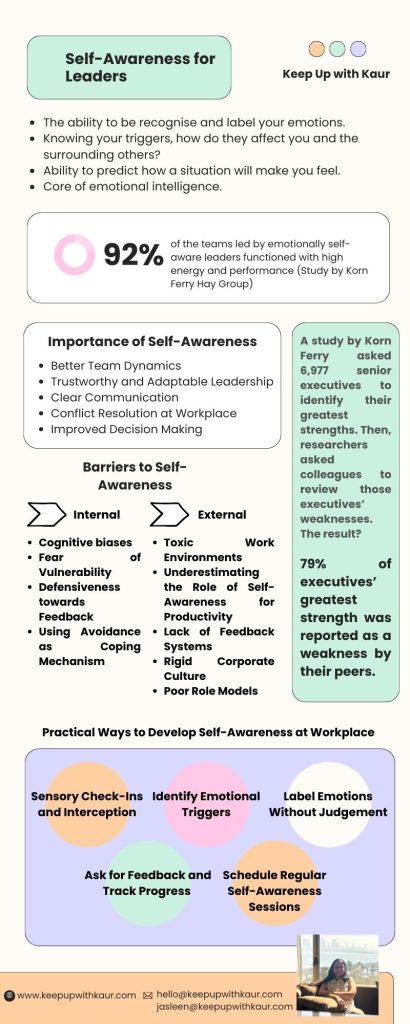
A study asked 6,977 senior executives to identify their greatest strengths. Then, researchers asked colleagues to review those executives’ weaknesses. The result? 79% of executive’s greatest strength was reported as a weakness by their peers.
Yep, it’s HARD to be objective about yourself. It’s not just about self-improvement. It impacts workplace dynamics, team productivity, and overall success.
You’re probably thinking this is pointless, right? What does working at a better company or even profitability have to do with the level of self-awareness at the workplace?
Hold on, we’ll get there.
Before we dive into ‘why’, let’s understand what emotional self-awareness is.
What is Emotional Self-Awareness?
- Self-awareness is the ability to be in touch with yourself and your surroundings.
- Knowing your triggers, how do they affect you and the surrounding others?
- It is the ability to recognise the exact emotion you’re feeling and, at some level, even predict how a situation will make you feel.
- It forms the core and the first step towards acquiring emotional intelligence.
P.S. If you want a deep dive into what emotional intelligence is, how it impacts workplace relationships etc., please read this.
Knowing your emotions helps you understand them, decode how others would comprehend them, and direct conscious emotional self-regulation to become a 2.0.
Breaking it down
Internal Self-Awareness
- How well do you know yourself?
- How are you affected by your surroundings?
- What keeps you motivated and driven?
- What ticks you off?
External Self-Awareness
- How does your behaviour impact others?
- Does your self-perception align with how others view you?
- How does your team respond to your actions? For example, how do they feel when you express anxiety through anger?
What is the Role of Self-Awareness in Emotional Intelligence?
Self-awareness is the first step towards emotional intelligence. According to Goleman, there are five components of emotional intelligence:
- self-awareness,
- self-regulation,
- motivation,
- empathy, and
- social skills.
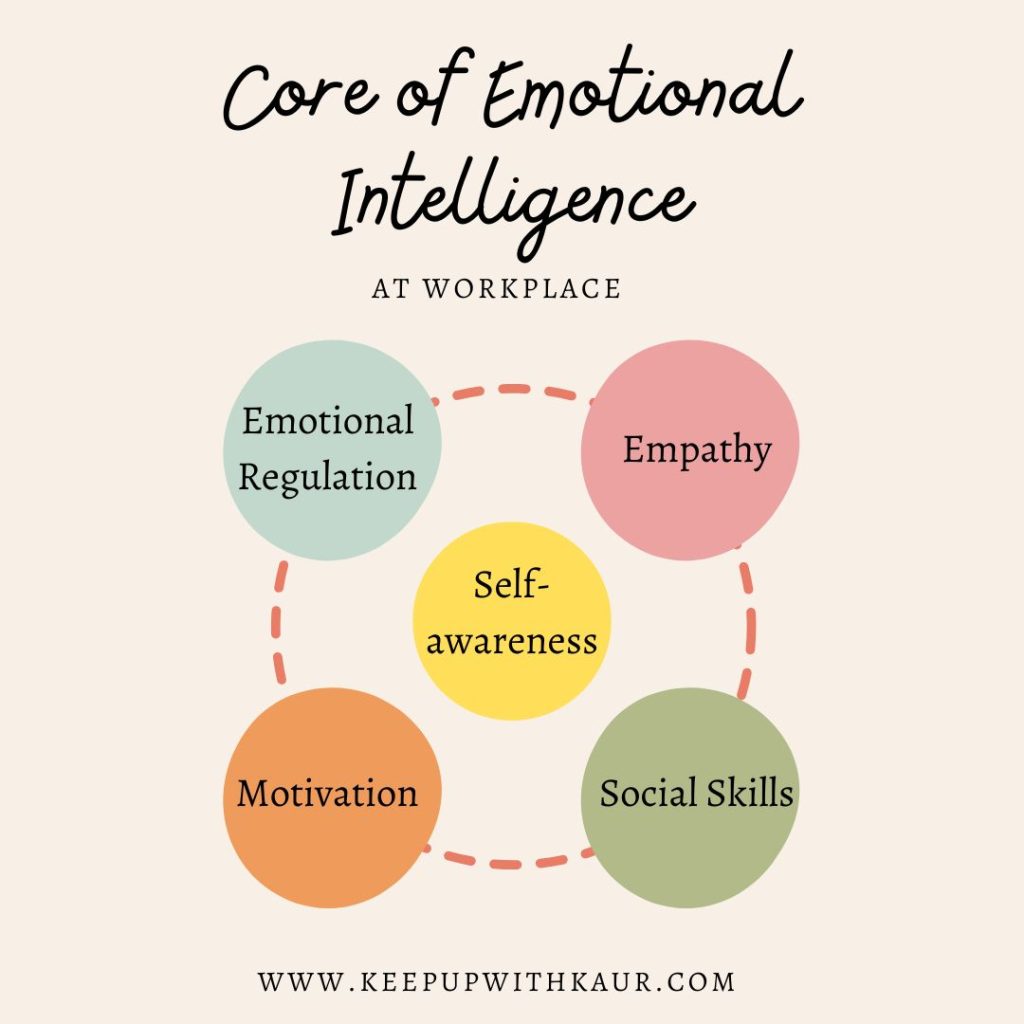
You need to know what to regulate, how to motivate, how you impact others and how interaction works for executing the other aspects of emotional intelligence.
Why is Emotional Self-Awareness Crucial for the Workplace?
Enhancing Team Dynamics
A very interesting study by the Korn Ferry Hay Group showed that 92% of the teams led by emotionally self-aware leaders functioned with high energy and performance.
Self-aware employees are less likely to be emotionally reactive. They are happy to collaborate with the team and are open to opportunities. Fea
Trustworthy and Adaptable Leadership
A leader who knows how her actions affect her team can regulate them better.
As a result, she can help to create an environment where people are least triggered and look forward to Monday mornings instead of dreading them.
Clear Communication
Seth Godin gives an excellent example to explain the importance of communication, where a comedian walks into a room full of people and tests his set right before his big show.
To his shock, he doesn’t get a single chuckle, let alone a laugh. He is furious, anxious and mad all at once. And that too right before his big show.
All this only to discover that his set was in English, but the room only had people who spoke Italian. For a good one hour, he was talking to people in a language they didn’t understand. How are they to understand the joke?
The point is, that communication only works when it’s understood. As a leader, you need to talk to your team in a manner they understand – by talking to them and not at them.
Be direct and say your piece without judgment but in a manner, they will listen.
Conflict Resolution at Workplace
As I said earlier, self-awareness is as much about knowing how you affect others around you as it is about understanding how the environment affects you. This helps you review every aspect of the situation from a more compassionate and empathetic perspective.
A direct result of better and more transparent communication in the workplace is a reduced likelihood of misunderstandings.
Better Emotional Regulation
Knowing that you’re anxious due to an upcoming meeting allows you to understand that emotion and not make any decisions amidst it.
You’ll know it’s time to take a break and return to the matter after collecting more information.
If you’re reading this, you know you’re breathing, but you may not be controlling it. But the moment you notice it, you can control it.
This is how better self-awareness sets the ground for better self-regulation. It is the first step towards better self-control.
Improved Decision Making
Awareness of a heightened emotional reaction prevents rash decisions.
Instead of jumping to conclusions and deciding based on assumptions and bias, you’re able to take a conscious step back to assess the situation and better direct your team.
Why Self-Awareness is Hard but Worth Every Effort
Self-awareness is important, but it’s hard. I don’t blame you for not checking in because it’s one, tedious to keep doing this and two, it’s hard.
- It’s hard to face the reality, especially when you’re not proud of it.
- It takes courage; requires you to be a bigger person stop constantly questioning yourself and be afraid of how others view you.
- It leaps to get out of your head. Simply because someone doesn’t like your reaction to one thing doesn’t mean they don’t like you.
But the criticism of your work doesn’t define you.

Think about it. Put yourself on the opposite side.
You like the work by a junior of yours and you see great potential. But you recognise they are rushing through their work because they’re stressing about meeting a deadline.
You see, the work and they’ve made the most obvious mistake in the document’s title that the client would’ve flipped over. Thankfully, you’ve caught it, so you go to them and tell them they need to slow down and read the document with a cool head before turning it in.
Does this mean you hate your junior? Does it mean you think she is a horrible person who can’t improve and has no hope? NOT AT ALL.
This is constructive feedback that can help her do better in the long run. The junior is lucky to have you around to contribute to them and add value to their work.
Now if only you get out of your head just like you’d want the junior to get out of theirs, how smart would you be to let others add value to you?
Barriers to Self-Awareness at Workplace
As simple as we make it sound to get to know ourselves better, it’s hard to fight the internal and external challenges that keep us from it.
Cognitive Biases
We may think we’re fantastic at our job. So much so, that even when your supervisors consistently tell you that you need to improve, you dismiss it without a second thought.
Fear of Vulnerability
We are wired to draw assumptions. If we want to observe and draw logical conclusions, we need to pause and consciously take in the facts.
What if the boss doesn’t appreciate me at all? What if asking for feedback triggers a series of negative observations that will eventually lead me to quit my job?
We’re all scared of criticism because we all fear vulnerability. We all want validation.
Defensiveness towards Feedback
As I said, some of us may view asking for feedback as a back-footed position where we’re handing the power to judge someone else.
Well, that may be the case. We are allowing someone else to judge our shortcomings, but that doesn’t make them more powerful.
Using Avoidance as a Coping Mechanism
When the reality is hard to handle, threatening or uncomfortable, we use denial to cope with the reality.
We love denial. If we don’t believe there is a problem, is there a problem? If I refuse to accept that a senior gave negative feedback, did it happen?
Makes life simpler, doesn’t it? No, it doesn’t because it’s temporary.
Toxic Work Environments
If your workplace doesn’t encourage collaboration and allows politics in the office, there is no accurate observation for you to note. Similarly, if your team is busy blaming each other, there is less scope for giving and taking feedback from them.
Underestimating the Role of Self-Awareness for Productivity
We’ve discussed how emotionally intelligent managers lead their teams to work to achieve the highest possible efficiency.
The team managers don’t understand how a team that gets along better with each other can perform vastly better in terms of productivity and profitability. Instead of driving performance using these tools, they over-emphasise increased working hours, more face time at work, etc.
Lack of Feedback Systems
Feedback systems present an opportunity to assess the direction of the performance at periodic intervals.
Even if the team is highly self-aware, a good feedback system enables the team members to communicate their observations and expectations clearly, setting the ground for formulating plans to improve.
Rigid Corporate Culture
In some workplaces, there are rigid standards for behaviour and fixed chains of communication. The culture of such environments discourages direct communication by breaking the chain.
Poor Role Models
Children replicate their parents and juniors at the office replicate their long-term bosses. If the leadership is unreliable and discourages discussions about performance and how to improve it, the team will mimic it.
Can You Learn to Be Self-Aware?
We’re all born and are instantly aware of the physical aspects of our body and the environment. But no one is born self-aware. It’s not a personality trait.
It’s a skill but not the kind that you learn once and then forget about. It’s an ongoing process. You learn to make a conscious choice every day to be self-aware.
You can cultivate self-awareness through dedicated time, commitment to emotional intelligence growth, and conscious effort.
Let’s talk about how.
Signs of Emotional Self-Awareness (or Lack Thereof) at Workplace
You’re Not Emotionally Aware if:
- You have difficulty accepting feedback.
- You don’t like it when someone criticises you. In fact, at some level, you’re probably thinking this post is not to help you but to blame you.
- You feel attacked even if a third person is being talked about in a situation.
- You don’t remember the last time you apologised for something.
- You do not know what triggers you, overwhelms you, makes you angry or stresses you out.
- Anyone who tells you that you are at fault is jealous or manipulative.
- You always feel misunderstood by others, but it’s never your fault.
You Are Not Emotionally Aware if:
- When someone gives you feedback, you don’t question their intentions.
- You know of the situations that stress you out or trigger you.
- You find it easy to trust people around you.
- If there is a misunderstanding, you don’t feel like it’s a burden to resolve it.
- You’re also open to apologising in situations.
- You can apprehend what situations will stress you out, so you plan accordingly.
- When someone points out an area of improvement, you don’t outright reject it.
- You know when there is a negative emotion incoming.
Free Self-Esteem Workbook
If you feel that you resonated more with the second part, you should also access a free copy of our self-esteem workbook by filling out the form below:
Practical Ways to Develop Self-Awareness at Workplace
Check-in with Sensory Experiences
Richard Davidson uses the term ‘interception’ to explain our perception of the internal signals of the body – the ability to notice the fastened heart rate, tightening muscles, clenched fists, change in the tone or the volume while speaking, burrowing brows, or the building up anxiety in the chest.
Each emotion triggers a specific response from the nervous system of the body. When you get angry, your heart rate increases, you will breathe faster, your pupils will get dilated and you’ll release adrenaline.
Take a few minutes to scan your body and note the sensory physiological responses. These will give you insightful cues about how you’re feeling.
Identify Emotional Triggers
Use a journal to go over your day to label the emotions you felt and the circumstances that made you feel that way. Discuss the wins and the losses, the challenges you faced and how you overcame them.
You can later use these triggers as the basis for further self-reflection and self-regulation.
If you want to learn how to be self-aware, this is where you start. Set a reminder on your phone for a weekly 20-minute session scheduled on a workday so you don’t get lazy.
Do this every week for about 6 to 7 weeks and you can then do this regularly and automatically without having to sit and journal for it all the time.
Label Emotions Without Judgement
We’re humans and as much as we hate it, we will be sad, disappointed, embarrassed, confused, angry, stressed, lonely, jealous, and happy at some point.
What you feel is not who you are. Label what you’re feeling without judging the emotion or yourself for feeling it. Be aware that you’re feeling it.
Feel free to refer to this post where we’ve discussed emotional awareness in detail.
Ask for Feedback and Track Progress
If you don’t even know where you started, how are you going to review and measure your progress?
You need a reference point to see and observe an actual improvement in your work performance, know how to fix it and check if the solutions you deployed are working.
You may think that you’ll remember the exact details of the feedback and figure out an improvement plan, but believe me, you need to record it.
Our short-term memory lasts about 15 to 30 seconds depending on the information and how much attention we pay to it. Without repetition, practice or rehearsal, the information will fade with time. This is just science.
Schedule Regular Self-Awareness Sessions
How often do you check in with yourself to figure out if you’re feeling disappointed, embarrassed, angry, sad, misunderstood, jealous, contempt, envy, disgust, fear, shame or threatened?
And how often do you check in with others and how they are feeling? What do they think about the team and how it functions? Are they even comfortable enough to express it to me and will I take it well and react constructively or use it against them at a later date?
These don’t have to be one-hour-long sessions. I’m talking about 5 minutes a day and maybe 20 minutes every week.
If you want your life to change, want to get better at your job, and have better relationships with the team members, it will not happen on its own. You’ll have to take small steps to make it happen.
Self-Awareness: Not a Destination but a Journey
You may know yourself well today, but you’ll go out into the world tomorrow, have new experiences, and need to learn about yourself again.
You may be highly self-aware at home, but you may not be in touch with your emotions and how others respond to your actions in a distinct setting, let’s say, at work.
Self-awareness is, therefore, a journey.
You brush every single day (I hope), bathe every day (mostly), and eat your meals (I’m sure) every day. It’s not that you can’t do something you’ve been wanting to do. You are lazy or you don’t want to do it badly enough.
This isn’t a one-time job. You’ve to do it regularly not as a chore but as an essential practice.
Final Thoughts
- Self-awareness includes internal and external awareness.
- Self-awareness is not a destination, but a journey.
- It’s supremely important because it forms the basis of emotional intelligence and relationship management in the workplace.
- Good relationships amongst members = happier teams = ready to collaborate = spend more time together where necessary = more productivity and greater efficiency = more profitability.
- 360-degree feedback is a good starting point for inculcating a culture of free-flowing communication for better work.
- Start your self-awareness journey today by:
- Sharing this with your team and implement this on a team level
- Asking for feedback
- Noting it in your journal
- Strategising how to go about the improvement and
- Setting a reminder for measuring progress and the next feedback check.
Yes, it’s that simple.


