Emotional intelligence accounts for 90% of the difference between average and exceptional performers.
Better work is more about building good relationships than we think. A team that likes each other is happy to collaborate, discuss ideas for the good of the organisation, and cover for each other’s shortcomings.
Not only do emotionally intelligent people perform better, but they also encourage others to perform better by laying good foundations for relationships, even in the workplace.
What is Emotional Intelligence?
Definition of Emotional Intelligence
According to Daniel Goleman, the author of Emotional Intelligence, “emotional intelligence” is the ability to understand one’s emotions and their influence on others, and the faculties to use them to communicate better.
Emotional intelligence allows you to have excellent knowledge of your feelings and equips you with the ability to manage them.
Importance of Emotional Intelligence for Relationship Management at Workplace
You can be a master at your job. No one else could do it how well you do it. But that alone is not enough to make you a good leader. You also need to be a better relationship manager.
More than the head, it’s managing from the heart that helps. Yes, even for increasing productivity and profitability in corporate enterprises.
What are the core components of emotional intelligence?
Goleman states that five components make up emotional intelligence.

Self-awareness
What are your shortcomings, strengths, emotions, triggers, and motivations? Which environment do you work best in? What helps you collaborate better with others and stops you from doing that?
A self-aware person is usually confident, has a healthy sense of self-esteem, knows their shortcomings and takes constructive criticism well.
It sounds simple; I know. But wait till you read this—the quality that 79 out of 100 executives reported as their strongest skill; others in the team reported it as the executives’ weakness.
Self-regulation
Knowing what ticks you off is good, but it’s useless if you don’t know how to regulate it.
For instance, if your juniors have made a mistake, it might make you angry, and that’s fine. The question is, how do you respond to that emotion?
Are you able to get a hold of yourself, or are you getting overwhelmed, losing yourself to your emotions by screaming at anyone who is in front of you?
Once you’re aware of your tendency to overreact or get angry over certain issues, you need to cultivate the tools to regulate that anger and not react on the spur of the moment.
How do you know if you need to self-regulate?
- If people find it hard to trust you, rely on you, walk on eggshells around you.
- You feel uncomfortable with change and find yourself stressed and unable to understand basic concepts for solving the problem.
Motivation
What drives you to do better? What drives your team to do better?
You can leverage that knowledge to inspire yourself and your team to improve performance and productivity by setting goals and rewarding the team members upon the achievement of milestones and goals.
How to determine if you or your team are motivated?
- Are they sluggish or energetic in the office?
- Are they excited about picking up new tasks or dreading them?
- How do they react when there is a challenging deadline approaching?
- Are they optimistic about the company and the team’s performance or not?
- Empathy
This is the ability to put yourself in others’ shoes and see things from their point of view. Empathy is at the root of many interpersonal aptitudes, such as teamwork, persuasion, and leadership.
As a leader, empathy will help you understand the feelings and shortcomings of your team and communicate better with them.
You should be able to notice their discomfort with the current state, look at their face and be able to tell that they have something more to add and ask questions to bring out the best in them.
You should be open to listening to your team and the solutions they propose, helping you become a better manager and decision-maker.
As an emphatic leader, you’ll see that your team likes you and will go the extra mile for you.
Social Skills
These are the skills to walk into a room, be in tune with the atmosphere, and regulate it.
Achievement of goals and functioning well in stressful environments requires a group of people to function in the same rhythm with each other.
It requires clear communication and understanding of goals amongst the team members. Everyone needs to be on the same page about what needs to be done.
Interestingly, if you are in tune with your own emotions, it’s easier to notice the emotions of others and communicate with them.
Why is emotional intelligence important for leaders and organisations: Research insights
Don’t have to believe me, but believe Goleman, who studied senior executives of 188 companies globally and found the divisions of managers who were emotionally intelligent, outperformed yearly earnings by 20%. That’s a lot.
There is a ton of research by psychologists that shows that people with better emotional quotient are more likely to succeed at work when compared to intelligence quotient.
Even kids who were trained in programs offering social and emotional learning opportunities had lesser suspension rates, attended school more often and were more disciplined.
When Goleman compared differences between average and exceptional performers, he was stunned to note that 90% of the difference in their profiles was because of emotional intelligence. Now that is an enormous number!
How does emotional intelligence impact team relationships?
The ripple effect of mood across teams
Yale University did a very interesting experiment in 1998.
They divided their volunteers into groups and planted actors among them. When given a task, the actor in the group always spoke first.
In group one, the actor, within one group, spoke with cheerful enthusiasm.
Another actor spoke with relaxed warmth in the second group.
In the third, the actor spoke sluggishly.
And in the fourth, the actor spoke irritably.
But like I said, he always spoke first.
The research found that the actor’s emotional state influenced the entire group’s mood. The feeling-good group was more cooperative, and that improved their performance.
Even the most effective leaders in the US Navy exhibited warmth, outgoingness, emotional expressiveness, drama, and sociability.
Now that I think of it, this is exactly how Sir Sam Manekshaw also is described in his autobiographical accounts. People still talk about his charisma, ability to inspire, and humble and considerate behaviour today, and these qualities continue to motivate crowds. What a great leader!
Your mood affects the surrounding people. If you can’t handle stress as a manager, the team is going to imitate you subconsciously and perform poorly.
Demotivated people, not toxic workplaces
I’ve heard people often casually remark their office is horrible.
The work sucks.
The culture of the team is highly toxic.
The idea of going to work on Mondays is distressing, to say the least.
More often than not, it’s not about the firm or the company, but the attitude of the team and the manager reflecting on the team.
Example of the impact of an emotionally unintelligent manager
Imagine a manager who has no control over his stressors. He gets angry at the drop of a hat and doesn’t hesitate before taking it out on the team.
How does it matter if a new employee is unfamiliar with the company’s practices? How does it matter if it’s a mistake doesn’t change the merits of the matter and is noticed by the other seniors whose job is the find those mistakes?
Instead of listening to his team and attempting to understand their point of view, the manager jumps to conclusions about their incompetencies. He loses himself to his anger and tells them they are worse than interns and what a big mistake he has made by hiring them.
How do you think this is going to affect the team?
Example of the impact of an emotionally intelligent manager
In a parallel universe, imagine if the manager, instead of resorting to yelling, had sat his team down and encouraged them to ask for help to understand how things are done.
Had he spoken to the freshers to identify why they didn’t ask their team members for help, they’d have felt more comfortable in asking for help the next time around.
How do you think the team would respond to this situation?
Building Happier and collaborative team relationships
I’m sure your answer to the above scenario was not far from the answers in the research findings.
An emphatic approach by the manager would’ve improved communication in the team and helped build trust among the team members and the leader.
The teams are happier, more satisfied and thus, more productive at work. Not a tad bit more, but about 8 times more productive than the unhappier ones.
These teams, unsurprisingly, are the core profit centres of any organization, and an emotionally intelligent leader heads them.
Better communication and conflict resolution
An emotionally intelligent manager communicates better by establishing clarity in roles and goals, and the team also emulates the same behaviour.
It results in better communication between the team and reduces the chances of conflict between the team members.

Signs of low emotional intelligence in the workplace
An emotionally unintelligent person is one who
- has a hard time understanding their emotions,
- often lose their cool,
- blames others for poor performance,
- doesn’t communicate goals, work and deadlines well, and
- is insensitive to others’ feelings.
At the workplace, the state of relationships is direct evidence of the level of emotional intelligence of the members and the management.
The members of such a team are often unhappy with the management, demotivated, feel misunderstood and are not willing to collaborate with other members of the team.
Chances are that team members don’t feel like they have a voice. As a result, the teams don’t function well and therefore don’t perform well.
Can one learn emotional intelligence?
The level of emotional intelligence depends on several factors, including upbringing, social circles, experiences, cultural influences, education and the environment.
It is not something we are all born with, although there is scientific evidence of some genetic influence on empathy, one of its key components.
Sadly, it isn’t part of the formal education system, and children don’t learn it unless they attend a special social and emotional learning program.
But it can certainly be learned. Leaders can be made.
How to Improve Emotional Intelligence for Better Relationships at Work
If a person is open to change, a focused and individualised approach based on increased motivation, extended practice and feedback helps to train the limbic system of the brain, the part of the brain that handles feelings.
Motivate people to change
In Goleman’s words –
“It’s important to emphasise that building one’s emotion cannot – will not – happen without sincere desire and concentrated effort. A brief seminar won’t help, nor can one buy a how-to manual. It is much harder to learn to empathise – to internal is empathy as a natural response to people than it is to become adept at regression analysis. But it can be done. Nothing great was ever achieved without enthusiasm.”
The first step is, therefore, motivation. Give people a reason to change.
You can use negative stimulants by telling people you’ll have them fired if they don’t deliver on time. Or, you can positively stimulate them by showing appreciation and faith in their abilities or rewarding them for a job well done—a method proven more sustainable and effective in the long run.

Journal for self-reflection
This is one tool of emotional wellness that I advocate for in each of my posts. I think.
At the end of each day, at least each week, sit and go over your meetings and interactions with your colleagues. Think about what worked well for you and others, what did not help, how did you react to someone expressing disagreement or missing a tiny detail, etc.
Think about where you are, who you want to be, and what would you like to change about these interactions by acknowledging you got triggered and observing what caused the triggers.
Pro tip: You can prepare your business’s books yourself, but a professional accountant, trained for years, will do a far superior job. Why doubt how much a professional can help you with your mental health?
Review these notes on a timely basis to stay on track and measure your progress.
Build emotional awareness
Feel free to refer to this post where we’ve discussed emotional awareness in detail.
Pick up your journal and name those feelings so you can start figuring out where they are coming from and walk towards a peaceful you.
It will be easier to deal with emotions if you know what exactly you are feeling.
Is it anger, anxiety, confusion, disappointment, loneliness, sadness, jealousy, or overstressed? What is causing it?
We can’t change the external circumstances but by tweaking our response to the situation, we can change the outcome. And to change the response, you need to look internally.
Learn Emotional Resilience
You’re not born with the ability to regulate your emotions.
But lucky for you, it can be learned.
Put yourself out of the setting, remove yourself from the environment for a bit, journal and let it all out, pause and look at the bigger picture.
Stop reacting, start responding
Before saying it out loud, think about whether you’re reacting, or are you responding based on logic and observation. Instead of responding at the moment, please take two minutes off and say it in your head first.
The signs that you’re reacting and not responding can be hard to notice at first. But it will become easier with practice.
The most prominent sign you can pick up for this exercise is to notice others’ reactions to you. Do they get nervous around you or can they express themselves confidently? Are they walking on eggshells when they communicate or openly crack jokes with you?
Some other signs that you need the time out before deciding can be your racing heartbeat, brain fog, anxiety, confusion, difficulty understanding simple issues etc.
As you start to become more emotionally stable, you’ll notice that your state directly affects the mood and motivation levels of your team as well.
Practice transparent communication
When you’re the one playing games, you’ll feel you’re smart, and nobody else can see what you’re doing. But trust me, even the dumbest person in the room can see right through your games.
So do yourself a favour and communicate directly with your team. Be clear about your expectations, honest about deadlines and constructive while giving feedback. Instead of judging, strive to develop a learner mindset.
Treat everyone with respect and empathy
Everyone has had a journey of their own to reach where they are today.
No matter who you are, what position you hold in the organisation, and how much money you earn, you don’t have any right to disrespect anyone. You may not like somebody or their style of working, but screaming and disrespecting will help nobody.
Take two minutes, remove yourself from the triggering environment and calm yourself down before you address the problem in such situations. It’s not hard. Treat them like humans.
Practice active listening
You may be fantastic at your job, but it’s futile to have a team to help if you refuse to listen to them and don’t believe in their abilities.
Encourage discussion amongst the team members and keep an open mind. Fresh perspectives will sometimes surprise you.
This will also help you listen to all voices in the room and make better decisions without being influenced by emotions, assumptions, and biases.
Take accountability for yourself and the team
It’s easy to check out when shit hits the fan and throws somebody else under the bus. But if you do it to somebody else, expect everybody else to do it to you.
Instead of throwing blame, try to figure out how you can fix the problem and prevent it from reoccurring.
For example, if you haven’t gotten feedback, ask for it instead of waiting. If the work is delayed, ask your team directly if they need more resources, rather than assuming laziness.
Give second chances
Like you, everyone has their bad days. Unless you’re God, I’m sure you have days where you find it hard to focus on work.
Sometimes, people take time to open up and learn about the environment and systems. Give them the time, space and support to upgrade.
Give them a second chance, like somebody else did for you.
Surround yourself with critics
It’s great to get constant validation for all your ideas from the people around you.
But it’s these people known as yes men/yes women who will also take you down because they will lie to you for their benefit at the cost of the organisation’s objectives. All they probably care about is their next promotion.
It’s best to surround yourself with people who may not always agree with you, but those who tell the truth. You should be wary of anyone who always agrees with you.
Building a Culture of Emotional Intelligence in Your Organisation
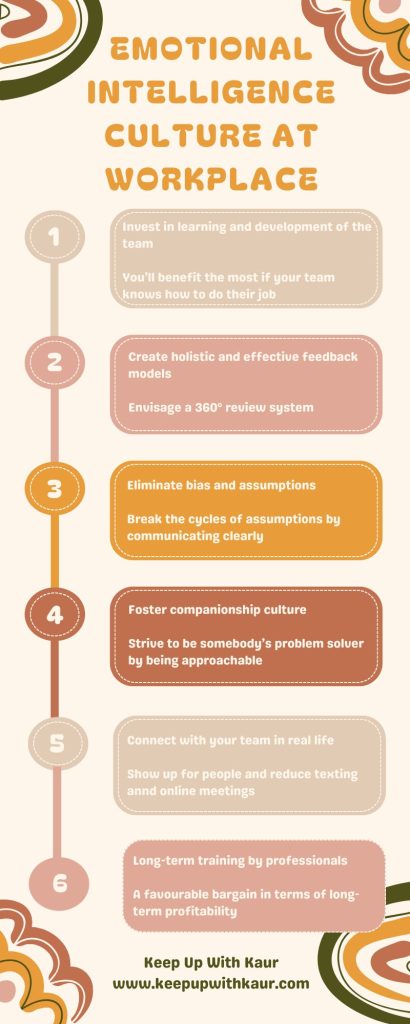
Invest in the learning and development of the team
Create an atmosphere where everyone has a say, encourages people to learn, teaches them how to express themselves and gives them a chance to improve their skills.
Take a personal interest in their learning and development, and watch them become motivated and improve their work on their own.
Think about it, if your team knows how to do their job better, the biggest beneficiary will be you and your organisation.
Create holistic and effective feedback models
Don’t give and take feedback for the sake of it. The best practice is to create a 360° review system which is taken seriously by everybody from top to bottom.
Don’t be dramatic while giving feedback. Instead, focus on genuinely adding value and helping them improve.
Be careful to ensure that feedback is based on observations regarding work and not on bias and favouritism. Remember, it’s the critics who are going to lead you in the right way and not the yes men/yes women.
And don’t forget to follow up.
Eliminate bias and assumptions
Our brains are trained to jump to conclusions in similar settings. It takes effort and practice to break the cycles of assumptions by communicating clearly and clearing the air.
Make that extra effort to question yourself when you find yourself jumping to conclusions.
Foster companionship culture
Whether you’re the boss or the junior, if you show up for your team, your team is going to show up for you.
But especially if you’re in a managerial position, strive to be somebody’s problem solver by being approachable and having an open door policy.
Connect with your team in real-life
Instead of sending get well soon messages, connect with them in real life and watch your team, do the same for you and each other.
As a result, their long working hours won’t seem so long, and they’ll be happy to cover up for each other as and when needed.
Long-term training by professionals
There is a reason you don’t self-medicate when sick, go to court and argue your case on your own, and send children to school to learn from teachers who are qualified to do the job.
Sure, you can try to improve everyone’s emotional intelligence on your own. You may even be successful once in a while. But because you’re not a professional, you may unknowingly make a mistake and do more harm than good.
This is someone’s life we’re talking about. For God’s sake, trust the professionals to do their job.
I know this is a cost, but remember we spoke in numbers about how productive, emotionally intelligent teams are? This will be a favourable bargain in terms of long-term profitability.
Final thoughts
- Emotional intelligence is more than a buzzword.
- It’s a path to better relationship management at the workplace and a tool for sustainable work environments resulting in higher productivity.
- Keeping people happy and treating them with respect are merely the basics.
- Inspire trust, motivate the team, create a collaborative culture and foster open communication.
You can continue to live a shit life. But if you decide it’s time to do better now, subscribe to our newsletter to learn how to live your dream life.


