The Tymoff philosophy is based on the understanding that we’re not flawless but still deserve to experience love in its purest form if we learn about acceptance in genuine relationships.
Given that most relationships end forever because of a lack of commitment, this quote is a much-needed reminder to not give up.
It captures the true essence of the Tymoff philosophy by nudging people to understand that no human being is perfect. If we are to find peace in relationships, we have to depart from the imaginary ideal scenario depicted in the rom-coms and accept ourselves as we are.
In this article, we will explore what it means to have a “true relationship”, how imperfections shape real love, and how to strengthen your bond through acceptance and mutual growth.
What does it mean to have a True Relationship?
There is no such thing as a perfect relationship because there are no ideal people. Just like a ‘perfect person’, the idea of a ‘perfect relationship’ is a myth.
But there is a “true” relationship, imperfect as it may be – just like this quote.
A true relationship is built on a foundation of love supported by honesty, integrity, trust, commitment and mutual respect. It’s a relationship in which you can be truly vulnerable without the fear of judgement.
It’s comes into existence when two people care so deeply about each other that they can look past their flaws to appreciate the other person for who they are. No matter what, the parties in this relationship refuse to give up on each other.
True Relationships are not Perfect Relationships
Can two imperfect people have a perfect relationship? No.
But can two imperfect people have a happy relationship? Absolutely.
In this article, we’ll discuss all the cliched advice on relationships and the emotional work that you have to do every single day.
I don’t mean to make it sound like a chore because it isn’t one and it shouldn’t feel like one.
It has to come from a place of love and mutual respect because you care about your partner and want this relationship to work. So shun the victim mentality and put in the work because it is so worth it!
The Power of a True Relationship
Aristotle cracked the code when he said that “man is a social animal”.
Life can be challenging. As human beings, we thrive in a group of like-minded people that support us.
As much as we’d like to be independent and gate-keep keys to our happiness, we crave emotional connections that help us belong. Feeling connected gives us purpose and drives the survival of the race.
In this study, the research team studied the brain scans of 2,500 people and showed them photographs of their acquaintances and lovers. The team noted that when people see the pictures of their lovers, their brain releases a massive amount of:
- dopamine, the hormone that helps you feel good,
- oxytocin, the hormone that makes you feel attached, content, calm and secure, and
- vasopressin that is linked to behaviour in long-term and monogamous relationships.
That’s not all. They also found that just looking at a loved one results in neurologically reducing negative feelings like fear and social judgment.
No wonder they say that love is euphoric.
In a world full of chaos, think what a ‘true relationship’, in which you and your partner love each other enough to look through the flaws and refuse to give up on each other, can do for you!
Why Should You Embrace Imperfections in Love
We idolise everything in this world. Everything has to be perfect. Are you a perfect human being? Do you know ANYONE who is a perfect human being? Hell, who is even a perfect human being?
P.S. If you can’t identify any faults or defects in yourself, you have a completely new problem to deal with because personality disorders like narcissism are very real. Please get professional help!
When you truly love someone, you want them to feel safe and secure, and you want to be the person who makes that space for them. It requires any extra effort to learn to accept your partner’s flaws. The love in the relationship automatically does that for you.
You want to do it because you want to be in a relationship with them. You appreciate their support and their presence fills you with pure joy. Remember all the mumbo-jumbo about dopamine and oxytocin we discussed above? It’s not work, it’s just something you want to do because you want to make it comfortable for the other person.
Side note – Let’s not confuse it with settling. Settling in a relationship is a sacrifice, but acceptance is trust and mutual respect from both parties in the ‘true relationship’.
How to Embrace Imperfections and Growing Together
We all live distinct lives and experience the same set of circumstances in different ways and intensities. We’re all dysfunctional. To expect a relationship with two dysfunctional parties to be a perfect one is setting it up for failure.
The point is, don’t aim for perfection because you won’t get it. Instead, aim to understand the imperfections, validate their feelings instead of questioning or trivialising them, and make space to allow them to be who they are.
It’s not about finding a perfect human being, but a human being who would be perfect for you.
Imperfections are Foundations of True Relationships
I have a problem with the word “perfection” when we use it in the context of relationships.
When you call a relationship ‘imperfect’, you’re still saying it lacks whatever it takes to be ‘perfect’.
The reality, in fact, is we are all built differently and will react differently in different situations. The different responses act as opportunities to set the groundwork for the relationship.
Let’s say you made a mistake at work and are guilty.
If your partner tells you that you’re making a big deal out of nothing and need to stop acting like a baby, you’ll feel judged and rejected – knowing not to express yourself again.
But if your partner comforts you and reinforces the positive belief that making a mistake does not make you a failure, you’ll feel secure and come back to your partner for some peace when you need it again.
Use the challenges in your relationships as catalysts for growth.
Acceptance Results in Increased Satisfaction
Relationships thrive on acceptance as we live to feel like we’re a part of something bigger than ourselves.
This is our innate nature. Acceptance of our true self by another person feeds that nature because it results in validation.
It translates into satisfaction and contentment in a relationship for the partner who feels understood and secure. And the satisfaction levels of the understood partner are projected on the acceptor as well.
All in all, it amplifies the level of satisfaction for both parties in a relationship.
Secure Relationships
This study of 209 heterosexual married couples showed that a person’s acceptance of their partner in a relationship is related to their and their partner’s level of satisfaction in the relationship.
True love is not asking your partner to change but to create a secure space for them and have them do the same for you.
When you do that for your partner, you invariably set an example for your partner to follow the course.
Stronger Emotional Connection
If every relationship was perfect, no one would ever have a chance to be there for their partner, who would never know how special they are to you.
As you make space for each other to be who they are, you’ll see your partner doing the same for you in return. Thereby fostering trustworthiness in the relationship.
You’ll be able to truly count on each other and see how it strengthens your emotional connection.
Vulnerability Promotes Trust
In a moment of weakness, when your partner is vulnerable, they’re taking a risk by sharing their thoughts and feelings despite the possibility of rejection.
When you show up for your partner in their moment of weakness, they register your presence. This ability to rely on your partner fosters trust in a relationship.
Don’t Tolerate Toxicity in Relationships
Accepting relationships as they are does not mean settling for someone who doesn’t meet your needs and puts up with an inadequate relationship.
If you already haven’t noticed it, the quote “a true relationship is two imperfect people refusing to give up on each other” focuses on the role of both parties.
A relationship in which you’re the only party accepting the other’s imperfections is not a relationship that this philosophy applies to. Where the imperfection becomes a toxic trait that suffocates your sense of self and self-esteem, you’ve tried everything to make it better. Don’t accept and don’t settle.
The idea is to be the person who would never give up on the person who didn’t give up on you, not the person who refuses to give up in a relationship that lacks the basics – love, trust and mutual respect.
How Can Imperfect People Build a Strong Relationship
Relationships are easy to initiate, but it takes a lot of love and a ton of cliched advice to maintain. You may happen to fall in love but it’s choosing to love every single day to stay in that place.
Ditch the idea of a perfect relationship and instead, focus on building a strong true relationship.
Look inward to become better self-aware
If you keep sabotaging your own love life, no matter what your partner does, it’s never going to be enough for you.
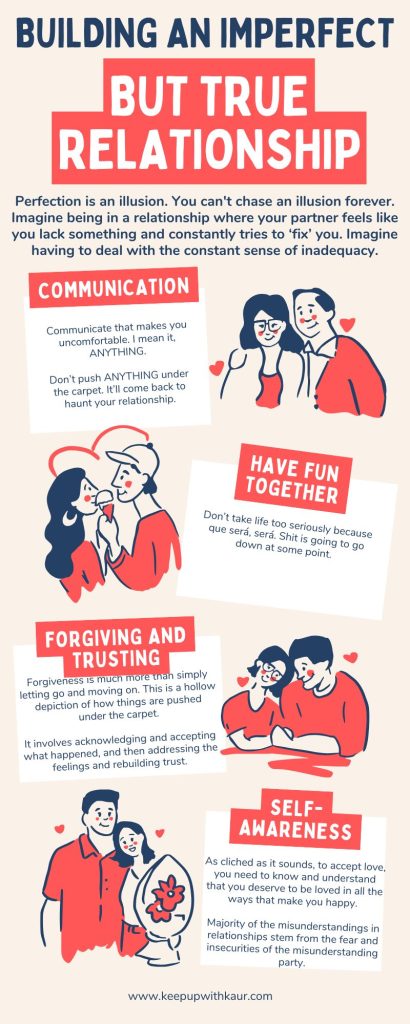
As cliched as it sounds, to accept love, you need to know and understand that you deserve to be loved in all the ways that make you happy.
The first thing you’ve to do is look inward.

Pro tip: Use a pen and paper for self-reflection. Writing helps the brain process better and improves retention.
Everything we’ve seen and witnessed until this point has influenced your internal wiring. Your surroundings and experiences have made you who you are today, the good and the bad. These experiences form the basis of how we perceive and process information.
If you’ve seen others around, you keep quiet, then talk about their problems and suffer when they did, you’ve learned to do the same.
You’ll be surprised to discover how the majority of the misunderstandings in relationships stem from the fear and insecurities of the misunderstanding party.
For example, if you’ve felt excluded from a group in the past, your partner’s act of not expressly inviting you to a dinner organised by them for their friends (because you’re a co-host) can feel like a trigger. You get the sense.
You can start this by thinking about:
- When was the last time you got irritated, angry or annoyed?
- Why did that happen?
- Does it happen a lot?
- Is there anything common about the reason for annoyance?
- Did you talk about it?
- If yes, how did that go? Were you able to communicate without anger or resentment?
- Are you able to make space for your partner’s needs?
Be Authentic in Your Relationships
You have flaws and that’s okay. Who doesn’t?
You can pretend to like something for a day or even a week. You can’t pretend to be someone else forever.
At some point, you will get exhausted from putting up a persona that doesn’t resonate with you. And when that happens, it will shock your partner because it’s only a matter of time before they realise that they barely know the person they’re with.
Focus on building a relationship which can be a safe space for the authentic you. After all, the basis of a true relationship can’t be a false persona.
Ditch the Idea of Perfection
Perfection is an illusion and you can’t chase an illusion forever.
Imagine being in a relationship where your partner feels like you lack something and constantly tries to ‘fix’ you. Imagine having to deal with the constant sense of inadequacy, feeling like no matter what you do, your partner will never be happy with you.
No surprise, Sherlock, you’re going to hate being in such a relationship.
Why would you create such an environment for your partner whom you love and care for? Stop chasing perfection and let your relationship breathe.
Practice Empathy for the Sake of Your Partner
The ability to understand and share a person’s feelings and perspective sets the groundwork for acceptance in relationships.
You and your partner want to be in this relationship and care about each other. This, therefore, shouldn’t be hard work when you think about how your actions affect your partner.
Every time you make an ask, be conscious of how you’d have felt if that ask was made of you.
Learn to Trust Your Partner
You and your partner may not be perfect and therefore, you can’t expect perfection.
But simply because they don’t qualify the false gold standard of being the perfect person does not mean that they’re not ideal for you.
You can and should expect them to meet your needs. But before you jump to the conclusion that the relationship doesn’t meet your needs, make sure you at least tell them what your needs are. It’s not as obvious as you think.
Take Ownership of Your Happiness
The relationship is to be fulfilling but you still need to be your person. If you put the whole burden of your happiness on your relationship, it will collapse under pressure.
If it momentarily is coming from the other person, it’s fine but know that it’s unsustainable. No one and no relationship can do that forever. Your happiness needs to come from within you.
Maintain Individuality but Grow Together
This could be a different article altogether. But to give you the gist, a relationship thrives and grows when both partners are happy and content in their own lives.
Whether it’s meeting your friends, continuing your hobbies classes, or focussing on your individual goals, don’t lose sight of the things that help you stay sane. It enhances your sense of self-worth and self-esteem; and in turn, helps you be a better partner in the relationship.
Team Up and Cover for Each Other
People change. You change. Over time, the dynamics in relationships may also change as it goes through ups and downs.
At times, you may need to adapt to new roles depending on the situation.
Keep in mind that your relationship is ultimate, nothing should come in the way. When your partner is low, you’ve got to step up. If she’s busy at work, you’ve got to take care of everything at home.
Live a Shared Life
When you’re with a partner, you’re building a life together.
Work on that shared life – build a home for the two of you, improve communication between you all, work out together, meditate together, and travel a lot!
Have Reasonable Expectations from Your Partner and Relationship
You should have expectations from your relationships – to be your safe space, your nucleus that you can bank on!
But will your partner or the relationship save you automatically? No. You will need to do that for yourself but you can use it as a support system rather than burden your partner.
- Your relationship can’t save you. You can.
- Be clear and vocal about the basic expectations in a relationship.
- Get on the same page about core values that would drive your relationship.
- Discuss how you’d like to resolve conflicts in the relationship because regardless of your denial, conflicts will happen.
- Discuss shared goals and views on how you’d want your life to look like in the future to ensure that the relationship is moving in the right direction and your partner has enough time to understand what to expect and prepare themselves for what’s coming.
Make Space for Their Needs
Make a conscious effort to understand what would make them happy.
What is one small thing that would pump up their whole day in the morning?
Ditch the Idea of an Equal Relationship
There will be times when you’ll be functioning at 10% but will need your partner to function at 190% to make up for it and vice-versa.
If your teammate at work unexpectedly had a personal crisis and went on leave, you’d have to take on more work to meet the deadlines.
Relationships, therefore, are not always going to be equal. Make peace with that and be ready to cover up for each other.
Learn How to Forgive
Forgiveness is much more than simply letting go and moving on. This is a hollow depiction of how things are pushed under the carpet.
It involves acknowledging and accepting what happened, and then addressing the feelings and rebuilding trust.
This brings us to our next point – communication.

Communication for Conflict Resolution
The quality of communication in a relationship determines how fulfilling it is for both parties.
What to Communicate
- Anything that ticks you off in the relationship.
- Anything about the partner’s behaviour that ticks you off and more importantly why?
- Is anything about the environment switching you off?
- Anything that makes you uncomfortable. I mean it, ANYTHING.
- Identify the tick and name the feelings underlying it.
How to Communicate
- Be clear about your needs.
- Communicate before you get angry and the resentment builds.
- Explain the feelings that you named.
- Wait for your partner to explain and make space for your vulnerability. Listen to your partner!
- Listen to them with empathy and compassion.
- Do the same for your partner when they need it.
- Do it without judgment.
- Don’t play the blame game.
- Give in to vulnerability.
Bottom line – Don’t push ANYTHING under the carpet. It’ll come back to haunt your relationship.
Have Fun Together
Don’t take life too seriously because que será, será. Shit is going to go down at some point.
Do things that you’ll both enjoy and cherish. Take a class together, do some DIY projects, play board games, do date nights often, watch a show together – just catch a break. Celebrate milestones and do those small crony gestures for each other!
Don’t let the rut get the best of your relationship.
Have a quality time together.
Signs Your Relationship Needs Professional Help
Relationships go through the usual ups and downs. They’re supposed to feel like warm hugs from the only person you want to hug whenever you need to. If it’s not feeling like it for a while, it’s time to ring the sirens.
It’s always a good decision to get professional help if:
- Communication doesn’t seem to be working
- Mistrust in the relationship
- Prolonged periods of stress
- Conflicts are unresolved and piling up
- The connection is missing
- You’re both arguing all the time
- Working on the relationship has persistently felt like a chore
- Your safe space is exhausting you
How to Save Yourself from a Toxic Relationship
Acceptance in relationships and true relationships does not mean settling in a toxic relationship.
Relationships in life are what drive us and keep us going. They form a holding ground for us to work off on and that’s how they should be. When you’re in a relationship, it shouldn’t feel like you’re always struggling to communicate and get or give attention.
Here are some signs to consider whether you need professional help in building a true relationship.
Acknowledge the Reality of Relationships
I know we’ve been talking about acceptance in this article and not changing the other person. But life is not always hunky-dory where the partner is also thinking about acceptance of your core needs and changing negative patterns for your sake.
People are fucked up. Domestic violence, mental cruelty, infidelity, and betrayal – is all real. And we can’t shut our eyes to it.
When Acceptance isn’t Enough
Acceptance in such situations won’t cut it because instead of strengthening the connection in the relationship, it will result in unhealthy patterns of compromising all the time and feeling inadequate and unfulfilled.
When your Partner isn’t Ready
It has to come from you and your partner. You can do all you want but if the partner is still emotionally immature or scared to get professional help, there is only so much you can do.
The Relationship Reeks of Insecurity
Relationships are for the long haul as they should be to help you stay stable and secure. But if you’re constantly only worried about your relationship, how are you supposed to go and achieve great things in life?
The Relationship Doesn’t Satisfy Your Core Needs
You deserve to be with someone who brings out the best in you, makes you feel comfortable in your skin and most importantly, satisfies your core needs of companionship, friendship, love and mutual respect.
Commit to Making it Work, if it’s Worth it
If it’s worth the effort, put everything into making it work. Do everything you think is necessary, including getting professional help.
Final Thoughts
- Don’t give up on your relationships.
- Both parties in the relationship need to accept the other person as they are.
- This is not work, if you love the person then you’d want to do all it takes to make them happy.
- Communication is key. This is what will make or break your relationship in the long run.
- Communicate without judgement, anger, or fear and be clear.
- Don’t play the blame game.
- Have reasonable expectations from your partner.
- But don’t compromise on your core needs.
- All of this applies to you and your partner because you alone can’t save what is made with two people.
- Get professional help if nothing seems to be working or it’s getting too much to handle.


