What if you could stay calm, collected, and in control—no matter the chaos around you?
As simple as it sounds, not reacting when you’re angry and not getting overwhelmed when emotions take over is challenging, to say the least.
You see, we’re born impulsive. We cry for food as babies, make a fuss if we don’t get attention, and demand that our demands are met instantly. But it’s not that we don’t learn self-regulation at all. We understand it through our circumstances, caregivers and the social set-up.
Learning it well, however, is a completely different story.
Self-awareness is one of the pillars of emotional intelligence alongside self-awareness, motivation, empathy and social skills. These together, define a team’s ability to work well with each other and drive an organisation’s productivity and profitability, even more than the intelligence quotient.
A person who can control themselves is more determined, prosperous, and in good physical and mental shape.
What is Self-Regulation?
If I were to explain self-regulation in three simple words, it would be this – “Respond, don’t react”.
Self-regulation is the ability to manage the emotions and control our responses to them. Being able to self-regulate means that you’re not a slave to them.
Instead of letting your emotions decide, you’re able to take a step back and judge the situations based on the consequences.
Let’s be very clear that we’re not talking about suppressing emotions or disassociating from them. The remnants of unresolved emotions stay no matter how hard you try to forget them. So if we resort to suppression, we’ll never move to the next stage with a clear head.
Feel free to refer to this post where we’ve discussed emotional awareness in detail.
Instead, use your emotions as guides.
For example (spoiler alert), if you’ve watched Inside-Out, recall how the anxiety got activated for all the right reasons. The problem wasn’t that the anxiety got activated – it was that it took over, bypassing Riley’s ability to make rational decisions.
The takeaway? Feeling emotions is healthy. Everyone goes through a roller-coaster of emotions in difficult situations.
The key is to process them, step back, and consciously figure out the right way to respond.
Do You Need to Self-Regulate?
Let’s consider a scenario:
You have a high-stakes document to deliver to an important client in one week. On a call, the client informs you they’re unavailable on the agreed-upon date, and you must submit it two days early.
The document is holding up the transaction, so postponement is impossible. The sole solution is to expedite and deliver it two days in advance.
Suddenly, the pressure is real. The time is short, and you must deliver before the initial schedule.
Now, consider your emotional response:
- You’re probably angry at the client for not informing you in advance. If you’re anything like me, you’re angry.
- You may be unhappy with your team, who failed to plan for contingencies and keep an adequate buffer.
- You may even get mad at your family if they feel your absence at home for a longer period.
- Now that you’re aware of the problem, how do you respond to these emotions?
Ask yourself:
- Are you finding it difficult to hold your voice down?
- Does the situation make you feel like crying?
- Are you going to yell at the client because you’re angry at her?
- Are you going to scream at your team for not having planned well? or
- Are you planning to direct your anger towards your family, who are at home waiting for you and feeling upset because they miss you?
- Will you get so restless that you can’t figure out how deep you are in trouble and how to escape it?
(Let’s call this set of responses ‘the Self-Destructive Reaction.’)
OR
- Are you going to acknowledge the emotions you’re feeling;
- Take a step back to remind yourself of what is important here;
- Take stock of the work;
- Brief your team members about the situation and check their availability.
- Reallocate the tasks and figure out the best way forward.
Check with the client to send a first draft (pre-finalisation) to get their views on the document.
You’re probably raising your eyebrows at me right now because “it’s not humanly possible to always accomplish all that you set out to do in a shorter timeline, Jasleen.” I get that.
But even in that situation, it’s not like the problem will solve itself. You still need to send the document to the client or inform them that the document won’t reach them. You can do that all angry, overwhelmed, and upset with everyone or calmly without your anxiety getting the best of you.
(Let’s call this set of responses the ‘Regulated Reaction’.)
I know it’s not always possible to be in an ideal Zen mode. We all lose our minds sometimes (source: trust me, bro – I would know). And that’s fine.
But it’s up to you to restore your emotional stability. You have to put in the work to self-regulate because the problem will not fix itself.
Coming back to the point, if you have a Self-Destructive Reaction and not a Regulated Reaction, you need to focus on self-regulation.
Signs You Need to Improve Self-Regulation
Here are some indicators:
Lack of Emotional Stability in Life
You feel overwhelmed and taken over by emotions frequently.
Unexplained Mood Swings
You find your moods changing quickly, from normalcy to sudden sadness without a logical reason.
Indecisiveness Caused by Stress
You find yourself stressed out and make decisions under pressure.
Making Impulsive Decisions
You jump to conclusions and rush through tasks and push the team to rush through theirs when given a deadline.
You act impulsively, without thinking about the consequences.
Feeling on Edge
You always feel you’re on the edge, about to let everything out. All you need is a minor trigger.
Over-sensitivity to Situations
You give extreme reactions to situations – it’s a hell yes or a hell no. There is no in-between.
You are very sensitive to criticism. Not only do you feel overwhelmed, but you also stress others out when given a task.
Difficulty Adapting to Change
You find it extremely difficult to be flexible in changing situations and schedules.
Frequent Outbursts
You often have emotional outbursts resulting in loud yelling or silent tantrums.
Inability to Focus under Stress
When stressed, it’s hard to focus on the task at hand, having to read simple sentences 2-3 times, and getting restless when you don’t understand it.
Difficulty Staying Disciplined
You fall out of line and are not able to stick to your routine habits when overwhelmed or stressed.
Signs of a Healthy Self-Regulation System
On the other hand, characteristics of good emotional regulation include:
- The ability to stay calm, despite the storm;
- The ability to continue your routine activities and stay disciplined, even when stressed;
- Ability to make quick and smart decisions even during a crisis;
- Openness to alternative solutions to the problem and
- Enter flexibility to adapt to the changing environment and circumstances.

Why is Self-Regulation Important?
You’re in Control
A reaction is automatic, but a response is crafted and delivered at the right time in the right way.
Just like you can’t control your emotions, don’t let them control you. I’m not saying they’re going to disappear, they won’t. You’ll still get angry, sad, anxious, stressed, and scared. However, self-regulation will allow you to control the response to those emotions. Instead of your emotions, you’ll be sitting in the driving seat.
Greater Life Satisfaction
According to the Journal of Happiness Studies, individuals who applied effective emotional regulation techniques reported a massive increase of 30% in their overall life satisfaction.
Reduction of Stress and Negative Thoughts
Although this is a huge number, it’s not shocking because the direct result of self-regulation is a clear head – not clouded by biases and overshadowed by negative feelings and thoughts.
As a result, it helps to reduce the overbearing stress, restlessness and panic caused by it.
Improved Decision Making
When you’re not thinking about what can go wrong, you start thinking about all that can go right in a situation. You can make an accurate assessment of the situation and make sound and logical decisions.
Improved Emotional Intelligence
Once you’re aware of your strengths, weaknesses, feelings, actions and motivations, and their impact on others and the environment, self-regulation is the second step towards improved emotional intelligence.
Enhanced Focus
Improved self-regulation and emotional intelligence increase focus on important issues—specifically, achieving the results without wasting resources or time managing the aftermath of an outburst.
Why do We Fail to Self-Regulate: Understanding the Root Causes?
Lack of Self-Awareness
This is big.
Without knowledge of internal and external circumstances, self-regulation becomes irrelevant, as there is no awareness of what requires regulation, when, or why.
If you’re not able to put a finger on what emotions you’re feeling, you need to read this post right after you finish it AND take notes.
We’ve covered this in great detail in this article.
Suppressed Emotions
The psychology expert Sigmund Freud once said that outbursts happen because our first-level defences fail. If you keep suppressing your emotions and ignoring the red flags or dissociating from them because confrontation is too much to deal with, eventually at some point, your brain will give up. Resulting in an outburst.
The choice is yours – a confrontation or an outburst.
Responses to Past Experiences
Stress triggers the brain’s fight-or-flight response, making the body react to perceived threats. According to experts in the psychology field, this may result from past traumatic or stressful experiences.
Lack of Opportunities to Learn Self-Regulation
As toddlers, we learn to self-regulate with the help of our caregivers. We respond to the soothing given by them and, over time, learn how to do that for ourselves.
If such training was missing in childhood, it is possible that you did not learn self-regulation because of a lack of opportunity.
While growing up, we may have seen our caregiver failing to self-regulate and witnessed their outbursts and breakdowns in stressful situations. Because of this, we now mimic their behaviours.
Social and Cultural Practices
Often, the juniors trained by toxic leaders learn the leader’s ways to get the work done.
The culture of seniors giving shit to juniors, and juniors accepting it from seniors, perpetuates in the organization.
Physical Causes
Physical exhaustion, lack of energy because of vitamin or mineral deficiencies, and low blood sugar may cause frustration and affect self-regulation.
Cause/Effect of a Mental Health Condition
The inability to self-regulate can be a cause or result of various mental health issues like anxiety, depression, a personality disorder or a stress-related condition – all of which require a professional’s help.
Steps to Self-Regulate in a Crisis at Workplace
Take a Re-Assessment Break
The idea of a break right in the middle of a crisis is to take back control. We should learn the art of dolce far niente.
Remind yourself that emotions happen, but you can choose how to respond.
During this break, acknowledge what you’re feeling, notice the emotions, and name them. If you’re too overwhelmed, try stress management techniques that work for you.
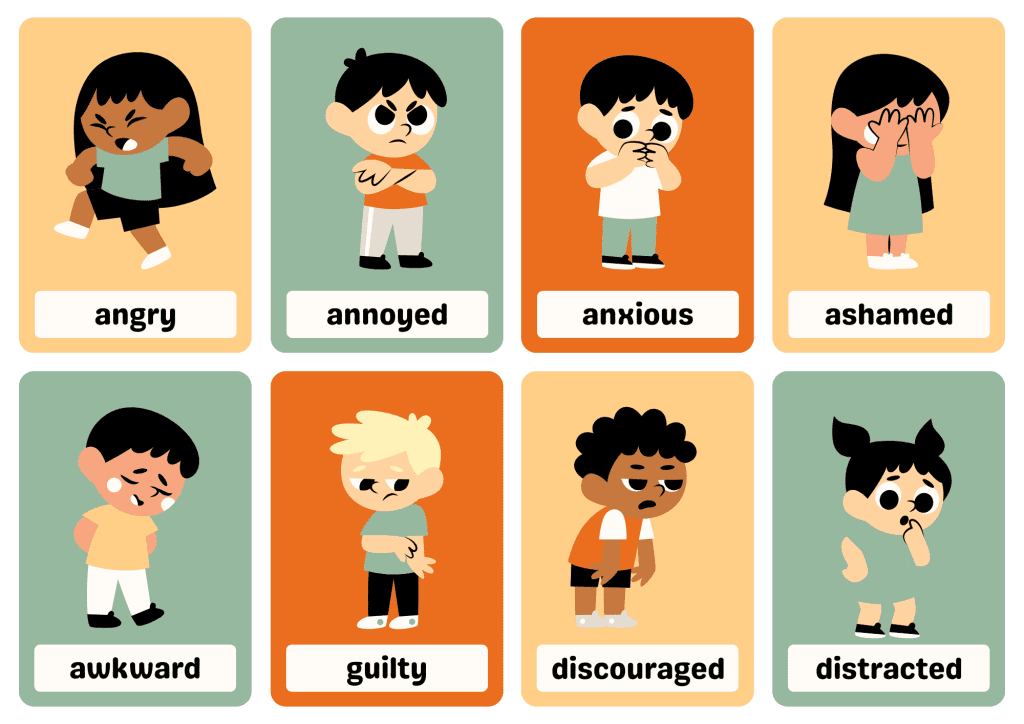
Here is what works for me:
- Sit comfortably in a chair and rest your feet on the ground.
- Notice how the ground feels, how the chair feels on your body.
- Is the ground or the chair cold?
- Count to 6 while breathing in and then count to 6 while breathing out. I swear it helps to reduce the anxiety in the moment.
Something that works for me is also a short-term distraction of bloopers from my favourite show.
Possible Responses
Once you’re calm and composed, come back to the problem and find out the best possible outcome you want to achieve.
Yes, many issues require attention, but is it possible to address them all without an outburst? Without stressing yourself to death? No matter what the situation, the answer to that question is always yes.
What are the alternative responses to the situation that will solve the problem at hand?
For instance, your junior forgot to submit her part of the work to you. As a team leader, you’re angry at her, afraid to tell the client, and freaking out about the impact of the delayed delivery on the year-end assessment.
The responses to this problem could be:
- Yelling at the junior and the rest of the team.
- Scaring her to death about her appraisal by telling her you’ll ruin her future in the company.
- Figuring out how to complete the assignment by reviewing the remaining work while she submits her response.
- Asking her why she couldn’t submit the work on time.
Consequences of the Responses
The last step in managing the crisis at work with self-regulation is to find out the potential consequences of the responses and choose the most suitable response accordingly.
- If you choose the first three of the responses in the above example, you’ll forget about the assignment that is to be completed. You’ll simply be sitting with a judger mindset which will consume all of your energies.
- As you scream louder or focus all your attention on her, the problem will just get bigger because now you have even less time to finish the job.
- If you choose the fourth one, it’ll help in the long run to ensure she delivers on time the next time around, but what about this time? The work is still not done.
- Also, in these situations where you yell at her/scare her/help her in the long run, the junior is most likely going to be too overwhelmed to be working on the assignment afterwards. There is a high likelihood that she’ll be slower at her job and might make mistakes.
- The ideal solution in this case would, therefore, be the third response. Finishing the assignment at the earliest and then discussing with the junior why she couldn’t submit the assignment on time.
Practical Steps to Enhance Self-Regulation
Make Space for Your Emotions
If you think avoiding your emotions equals self-regulation, then you could not be more wrong.
The reason people have outbursts in the first place is because they suppress their emotions for too long or their first-level defences fail. As a result, the body can’t handle it anymore and this results in an outburst.
Look at the Larger Picture
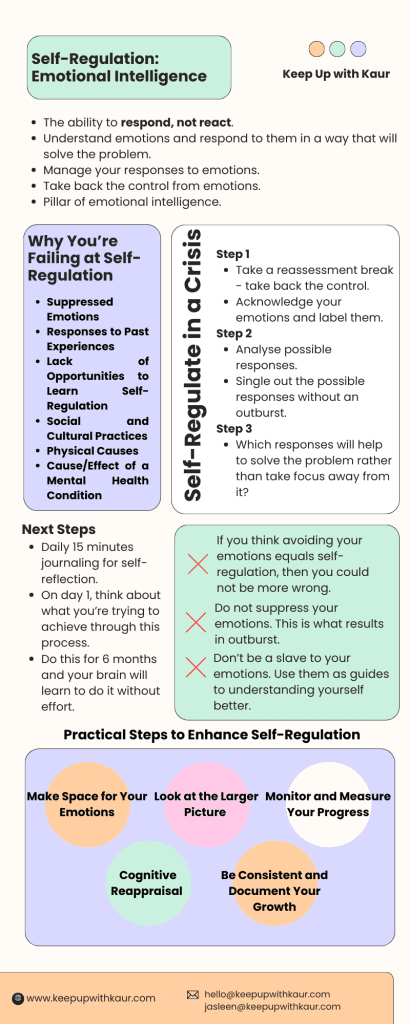
Before making any decisions while you’re overwhelmed or confused, think if this decision will matter 5 years from now.
This can be your key to controlling your impulsive behaviour and focusing on the achievement of the goal rather than getting lost in the minor issues that won’t matter in the next 15 days, let alone a year.
Monitor and Measure Your Progress
Always record and monitor your progress. Without it, you won’t know how far you’ve come, how much further you need to go, and how to get there.
If similar situations are causing similar negative emotions for you, you’ll know to focus specifically on that situation next time to stay calm and regulate better only if you have the situations and emotions documented in one place.
Cognitive Reappraisal
You will have negative thoughts. This is not something you can run away from. What you can run away from instead is how long they last and how much they impact you. In the long run, this technique also helps to improve long-term mental health.
This technique helps you identify negative thoughts, reframe them to look at the silver lining or the positive side and reduce the negative effects.
In the long run, you’ll be able to train your mind to do this without a second thought. It’ll be second nature to you.
Be Consistent and Document Your Growth
Just like emotional intelligence cannot be learned all in one seminar or article, mastering self-regulation requires more than reading an article and hoping for the best.
If that is your approach, then let me break it to you already. It will not work. Be consistent with this practice to make sure it sticks.
Next Steps
- Spare 15 minutes a day for journaling and self-reflection by going over your day.
- Start on day 1 by thinking about why you want to do this. How would you feel if you managed to discover your greater potential during the process? Write this down.
- It’s only 15 minutes a day, for a calmer, more stable version of you. Is that too much to ask?
- If you do it every day for 6 months, your brain will automatically learn the steps to self-regulation without you having to put in so much work.
- If you find it difficult to stay consistent, read what you wrote on day 1 (Second point).
Final Thoughts
- It’s okay if you overreact sometimes. You’re only human. Please be kind to yourself.
- If it happened, acknowledge it and learn from it. Why did it happen? What triggered you?
- Once you know, you can work on a better way to address the trigger the next time.
- When you recognise the roots of your self-regulation struggles, you can address them at the source, rather than just dealing with surface symptoms.
- Self-regulation isn’t about perfection—it’s about progress. Start small, stay consistent, and watch as your emotional control transforms your work and life for the better.


