In 2016, a friend of mine was diagnosed with an autoimmune disease called autoimmune hepatitis. Hepatitis affects the liver so doesn’t sound like anything to do with emotions at all. Let alone emotional suppression. Wait till you read more.
The doctors told him it was genetics. But neither of his parents had that disease. This friend also has an identical twin. He (thankfully) didn’t have the disease either.
The doctors could not pinpoint why it happened. He had just one serious bout of hepatitis once before in childhood, and the chances of the liver having been weakened by that was susceptible to inflammation thereafter. But this was just a hypothesis by an expert five years later.
Also, it primarily affects Asian females over 35, and a male under 25 getting it was extremely rare so the doctors didn’t have any good cases to extrapolate or give a prognosis from either.
As of date, there isn’t much research on what causes autoimmune hepatitis. Yes, it’s genetic, but due to faulty or damaged genetics, not some latent gene. There’s no real known cause.
What the doctors said about autoimmune diseases
Why and how did the gene disease activate for this friend and not his twin brother?
When he asked the doctor what caused it, the doctor casually responded that the actual cause of such diseases was unknown.
Some five years later, when consulting one of the country’s best doctors in the field on the course of treatment and taking a second opinion for the first time, the doctor asked him, “How was the environment at home before you first got the symptoms?“
He didn’t ask him what he ate, how much water he drank and how often did he exercise. Mind you, he was one of the most physically active and fit people I knew back in college.
I reiterate, that the doctor asked him how was the environment at home before he got the symptoms.
Later, around 2019-20, another friend was also diagnosed with rheumatoid arthritis, also an autoimmune disease. I knew she had moved across continents at a very young age and it could NOT have been easy to start a life all on your own when she was only about 17-18 years of age.
It can get very real and very brutal, all too soon. And for her, it did. The doctors told her also that while the actual cause is unknown to medical science; it was probably just stress.
Just stress? We’re not talking of a minor inconvenience but a life-threatening disease where the immune system of the body fails and takes the position of an attacker instead of a protector. It cannot differentiate between a cell of the body and a foreign cell and attacks every cell simultaneously. These diseases can be managed but can never be cured.
The Cost of Emotional Suppression
The stories above are personal accounts of people who have to live with an incurable autoimmune disease for the rest of their lives. These are people I know and care deeply about.
I recently finished reading ‘When the Body Says No: The Cost of Hidden Stress’, authored by Gabor Mate. Mate is a doctor who treated multiple patients for medical illnesses and addictions. In his 20 years of practice, he worked with patients who suffered terminal diseases like cancer, ALS, arthritis, multiple sclerosis etc.
While examining patients, he started noticing patterns: people with immune system illnesses, whether autoimmune or immunodeficiency, had often experienced trauma before their diagnosis. So he started talking more to his patients about these traumatic experiences.
Shockingly, the stories of my two friends fit right into the supposed personality traits Dr. Gabor had talked about in his book.
Let’s delve into those a bit deeper.
Personality traits of patients with immune system illnesses
He found these patients had similar underlying emotional personalities, and they dealt with their emotions similarly. The common underlying traits he noticed were:
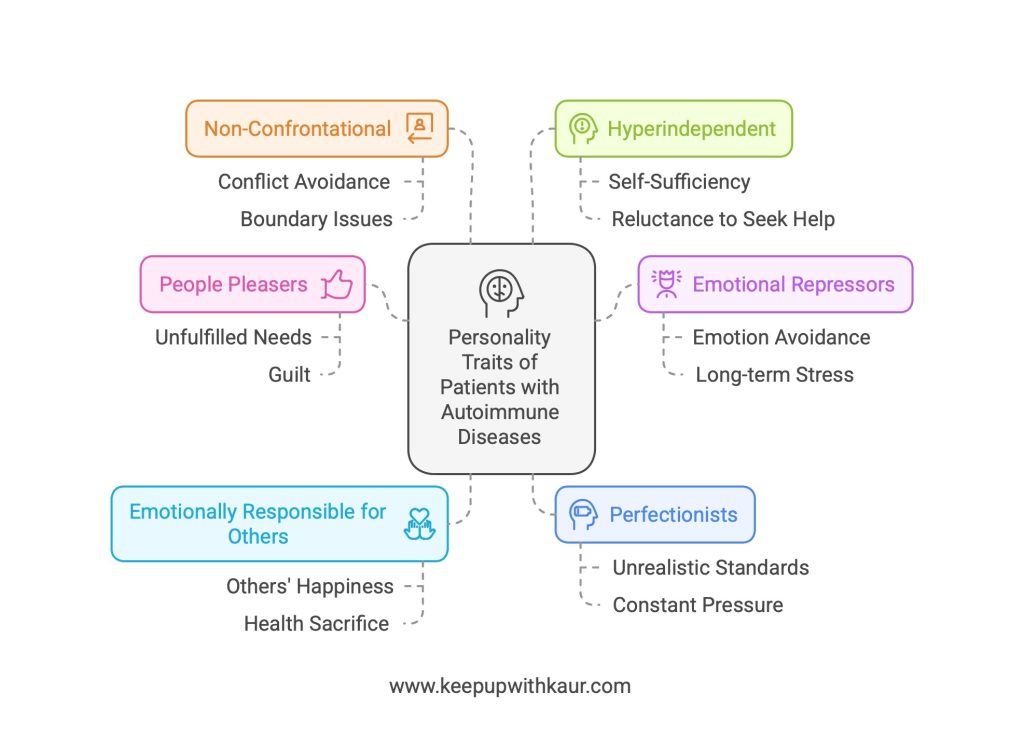
People pleasers
He noticed these people went out of their way to meet others’ needs, while their needs remained unfulfilled. They had a hard time drawing boundaries with others and saying no.
If they even considered prioritising themselves, they were overwhelmed with feelings of guilt and were harshly self-critical of themselves, feeling like they were too needy and not cared for.
While taking care of others’ needs, they forgot what it was like to take care of themselves and kept going for the sake of securing external validation. Their stress hormones increased, causing burnout. Eventually, their bodies could not handle any more stress and they gave up.
We’ve dug deep into people-pleasing tendencies here. Click to find out if you’re one of us.
Emotional repressors
Emotions, especially, anger, are healthy responses to the environment. But these people also didn’t know how to process emotions, so they just didn’t. They avoided their emotions and invalidated them because it was too hard to deal with them. In the short run, it was great because they could just move on, but in the long run, they felt helpless and frustrated.
The repression built up stress in the body and at some point, it couldn’t handle it anymore.
Emotionally responsible for everyone
These people often felt responsible for others’ happiness. As a result, they only cared about making others happy even if it meant paying the price with their health.
Perfectionists
‘Good enough’ isn’t good enough for some people.
These people set unrealistic standards and beat themselves over not achieving them. They’re under constant pressure and, literally, scared to face failure.
Non-confrontational
We’re talking about people-pleasers and emotional repressors here. At no point were these people comfortable in confronting the other parties about violating their boundaries.
For example, if a non-confrontational person has to deal with bullies. He would detest the idea of standing up to the bullies; first, because they refuse to acknowledge that they were victims of bullying, and second, because they fear that other people might not see their behaviour as particularly friendly.
Hyperindependent
It’s hard to be hyper-independent and do all of life on your own. There are failures, terrible accidents, and bad days to deal with.
They firmly believed that even if they asked for help, no one would oblige. As a result, they don’t ask for help and are fairly self-sufficient in all aspects.
All of this led me to dig a little deeper.
What Does Scientific Research Say About Stress and Disease?
I came across various independent studies on this topic, all of which are divergent in their conclusions. However, the National Cancer Institute, a leading federal agency for cancer research in the United States, concludes that stress may indirectly cause cancer by leading to unhealthy habits and lifestyles.
I recently checked in on a third friend of mine, who had also received an autoimmune disease diagnosis (Celiac Disease) a few years ago. He had moved cities, was in a completely new environment, and had lost a ton of weight. Turns out, the timing of his diagnosis coincided with the stressful period in his life.
Although my sample size was fairly small, all three of my friends were as young as ever and received diagnoses of autoimmune diseases in their early 20s following extremely stressful periods in their lives.
More recently, in September 2023, this study published in the International Journal of Oncology supported Dr. Gabor’s hypothesis and concluded similarly that:
“The present review indicates that stress has been linked to cancer development and incidence for a number of decades…Recent research has advanced the current understanding of the role of stress in cancer induction, growth and metastasis development… Animal studies have revealed a clearer link than clinical human studies, suggesting that stress factors can exacerbate cancer hallmarks and promote growth and metastasis by directly affecting malignant tissue, its microenvironment, anti-tumor immune activity and other indirect cancer progression modifiers.”
How does that even work, you ask?
How Does Chronic Stress Impact Physical Health?
The National Cancer Institute describes how the body responds to stress by releasing stress hormones that result in increased blood pressure, heart rate and blood sugar.
In the short run, the body needs these hormones because, according to the body, it’s under threat and is accordingly preparing for the fight-or-flight response.
Now imagine if the body remained in this state for a prolonged period. To keep up, it would release more of such hormones over time, causing the body to undergo stress over a prolonged period, causing inflammation, and weakening the immune system.
Steps to Combat Stress-Induced Health Risks
What can you do about it?
To be honest, Dr. Gabor’s answer is quite straightforward. He suggests addressing the underlying causes that contribute to the stress. As straightforward as it is, it’s not simple. Running away from emotions is easy, but facing your emotions is HARD.
This is what Dr. Gabor suggests in his book:
Self-awareness and acceptance
At the very outset, it’s hard to accept that you need help because you live for external validation and don’t value yourself as much as you should.
But it’s possible.
It’s possible to do the hard work, live your dream life, be proud of yourself for facing your scariest moments, deal with your deepest, darkest fears, discover your true self and attain your freedom.
But it won’t happen automatically. You’ll have to unlearn how you treat yourself as less important than everyone else and how you attach value to yourself.
Click to read and implement the Self-Awareness Guide if you need one.
Listen to your emotions and body
You’ll have to learn to listen to your emotions and stop ignoring them. Identifying that you’re uncomfortable is one thing, and naming your feelings is another. That is exactly what you have to do.
For example, when someone is screaming, you can see they’re not themselves. To help, you’ll have to get under the anger and identify that they’re feeling left out, unheard and misunderstood over and over again.
A quick tip: If you relate to the anger example above, you can use the anger-iceberg tool to unearth the roots of it. Read more about it here.
I truly wish emotional awareness and regulation were taught to us as children. We need a formal lesson where we’re explained what it means to be angry, disappointed, sad, misunderstood, stressed, overwhelmed, anxious, shocked, happy, excited, joyful, confused, and disgusted.
But since not all of us had that opportunity, we can thank the stars that you’re reading this and starting today. It’s time to take accountability for our lives.
If you need help identifying and understanding hidden emotions and building emotional awareness, we’ve covered it in great detail in one of the sections in this post.
Draw healthy boundaries
Once you learn to tune in with your emotions, the next step is to act on them and deal with the discomfort of drawing healthy boundaries.
As a people pleaser (trust me, I know :)), you seek external validation. Drawing boundaries by saying no or telling someone off might make you physically uncomfortable.
People with whom we need to draw boundaries, don’t always come in the shape and form of bullies. Sometimes they’re closest peers or even family members who are habitually accustomed to overlooking your needs because that’s the standard they’ve learned to work with you on.
As hard as it sounds, when you tell them what’s been really going on, believe me, they will listen if they care about you. And if they don’t listen or care, are such people even worth losing your mind over?
We’ve done a deeper dive into drawing boundaries. You can read all about it here.
Become Friends with Confrontations
Your needs matter. Your feelings matter.
A confrontation is probably the last thing on your mind, but the act of confronting itself is drawing a huge boundary. But isn’t a confrontation better than dealing with the emotional baggage than knowing that once again, you let someone else walk all over your needs?
But if you don’t tell them to back off, no one else will. If you don’t tell them they need to value your needs, no one else can.
The change has to start with you.
Be kind to yourself
Yes, the change has to start from you, but it must come from within you.
Life is not perfect for anybody. How we deal with life can also vary vastly.
But life happens to all of us and it probably happened to you, too. It’s time to stop judging yourself and staying in the same state. It’s time to create the space to help you flourish and thrive personally and professionally.
Self-Care: Reconnecting With Your Authentic Self
Self-care is truly underrated.
When you’re sitting on a plane and the oxygen levels fall, there is a reason they tell you to wear your oxygen mask before you can help others do the same.
If you wear your mask first, you can help three or five others with their masks. But if you start by helping others, you’ll at max one or two people and end yourself in the process. It’s of no good.
You have to prioritise yourself even if you want to care for others.
Overcoming Hyper-Independence: Why Support Systems Matter
Who doesn’t love a friend checking up on them when they’re low? Who doesn’t appreciate sitting quietly with their partner and doing their own thing? If you don’t, you never crossed the self-awareness stage because you’re still in denial. Please scroll back up to the awareness section. 🙂
As much as we’d like to be hyper-independent and self-sufficient, we all love real connections.
Surround yourself with people who help you, support you and bring out the best in you. Ditch those who refuse to acknowledge that you are moving forward and pull you down by telling you that you used to be nicer earlier. They don’t see that you have vulnerabilities and basic needs that must be met for your happiness.
If they refuse to see that even after you expressly tell them, are they worth spending time and energy on?
Final Thoughts: Taking Control of Your Health and Well-Being
While reviewing the book on my Goodreads account, I saw a few critical reviews that blamed him for victim blaming. Well, from one perspective, it is sort of true, because they’re going through enough shit. To simply tell them that they’re suffering because they didn’t know how to draw better boundaries and take care of themselves, is cruel, to say the least.
But that’s not how I understood the book because the truth is that he worked with his patients holistically – giving the required medication and helping them build an environment in which they could return to their lives happier and safer.
He has given us a roadmap for a happier and more fulfilling life.
You start your journey on that road by journalling.
I suggest journaling in all my posts because, believe it or not, the first step towards getting better is getting to know yourself. Of course, it doesn’t make a suitable substitute for a qualified and trained professional who can help you heal. But understanding your inner self, and facing the fears and reality is the first step you will need to take before you can change it. If you’re not ready to see a professional yet, this will help.
It’s a wonder that some minor changes in our lives, which are all in our control, can change the face of everything we’ve ever known.
Isn’t it worth giving them a fighting chance? You deserve a good life and you can create it.


