The society gives us decent training in navigating relationships—romantic, familial, and professional, at least on the surface. But what about self-love?
People ask how your partner is doing, how your parents are, and sometimes even about your work friends.
But rarely, if ever, does anyone ask about your relationship with yourself.
Books, movies, and plays dive into the drama and depth of ideal relationships—with lovers, friends, and family.
We grow up absorbing messages about what it means to show up for others: be honest, loyal, kind, and empathetic.
But no one teaches us how to apply these same values to ourselves.
Not that the other relationships aren’t important. They are.
After all, everything we do as humans stems from a deep, evolutionary need to belong—to feel part of something bigger than ourselves.
But none of those relationships compares to the one you have with yourself.
Because your self-love—or lack of it—shapes how you show up in every other part of your life.
If you don’t like who you are…
If you feel you’re not enough, or second-guess how you come across to others—
That feeling will seep into everything: how you speak, how you connect, how you carry yourself.
The world then sees a version of you filtered through self-doubt, not self-love.
But the real shift doesn’t come from how others see you. It comes from how you see yourself.
And building that kind of self-love? It starts with two simple practices grounded in psychology:
Two simple and science-backed ways to get started
Ask Yourself Better Questions
Your brain is a supercomputer. It answers whatever you ask, without judging whether the question is helpful or harmful. But it’s not as rational as you’d like it to be.
So if you ask, “Why am I like this?”, “Why am I ugly?” or “Why can’t I just get it right?”—it’ll search for reasons to confirm those beliefs.
But if you shift the questions, you change the answers.

Try asking yourself:
- What makes me happy?
- What am I grateful for?
- Who are the people in my life I thank God for?
These questions help redirect your focus toward what’s working and remind you of the goodness that already exists.
That’s where self-love begins—not with grand gestures, but with subtle shifts in self-talk to train your mind.
Use Affirmations to Rewire Your Inner Dialogue
I used to think affirmations were a funky business. The idea of repeating nice things to yourself out loud feels odd, to b honest.
But neuroscience says otherwise.
To quote from this paper, “results highlight ways in which brain systems implicated in positive valuation and self-related processing may be reinforced by prospection and suggest novel insight into the balance of processes supporting affirmation.” Repeating affirmations helps rewire thought patterns by reinforcing helpful beliefs, especially when your mind spirals.
Think of them as mini-nudges to bring your brain back when you find it steering the wrong lane.
Try ones like:
- I deserve to be loved and cherished.
- I deserve to be heard.
- I’m a cutie. (Yes, this counts, and yes, you are.)
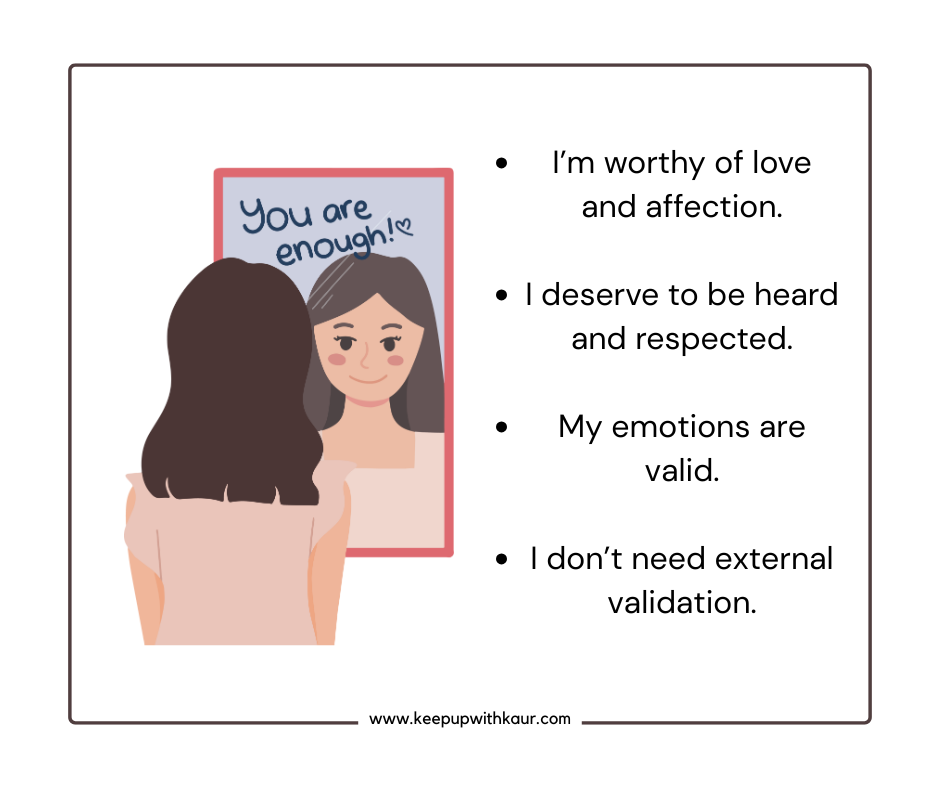
Self-Love Starts Small—But It Starts With You
You may not believe them at first. But as the re-wiring of the brain progresses, it’ll create a safe space for these beliefs to grow and take shape. That’s the foundation of self-love: building a safe place within your own mind.
No one else can build your relationship with yourself but you.
And it starts with small, honest steps—questions that matter, words that heal.
If you liked this, you’re going to love this piece on self-regulation.
Love,
Jasleen
Quote of the edition:
“The truth will set you free. But first, it will piss you off.”


