I was about 13 years old in 2008 when I moved to a boarding school far away from home.
Obviously, at that age, I didn’t even understand what ‘mindset’ meant.
Looking back now, it’s almost unbelievable that something I couldn’t even name would completely transform my entire school experience.
But before we go on with the story, let’s understand what mindset really means.
How is mindset defined?
According to the Cambridge Online Dictionary, it is a person’s way of thinking and their opinions. The Merriam-Webster Dictionary defines it as a mental attitude or inclination.
Mindset refers to the pattern of thinking, the beliefs and attitudes that help you plan your point of view.
To give you a few examples:
- Do you see failure as another testament to your terrible destiny, or do you see it as a stepping stone to success?
- When you’re picked for a specific assignment by your boss, do you see it as being singled out and laden with more work than everyone else, or an opportunity to prove again that you’re worth giving more work to?
- If your friend cancels out on dinner, do you trash your relationship with your friend? Or do you understand that she probably has some work to do or doesn’t want to leave the house because she had a rough day and has nothing to do with you or your relationship?
- Imagine you have a fun outing planned with your family. Are you worried about travelling and stressing about the outing or excited and looking forward to relaxing?
Your mindset is, therefore, how you view different situations.
How did reforming the mindset help me?
I learned about the school from one of my god-grandparents. The school was in the perfect location, on a hill surrounded by mountains.
I loved hearing his stories and the idea of living with friends from different parts of the country, all living together in a dormitory, playing sports, and going for my hobbies sessions after classes.
I remember saying bye to my parents at 5.30 p.m. the day my parents dropped me off. Standing on the sides of the parking lot next to the girl’s dormitory, I waved at the car fading away from my sight.
Even though I was a confident young girl when I shifted, it was daunting to be seated in a class of unfamiliar faces. But I was excited to live the dream!
In the following days, the girls in the dorm helped me prepare for school and ‘study hour’, and took me around the school to classes and back.
They braided my hair and helped me figure out the clothes for the different sessions. This by the way, was a lot of help because we wore the sports kit for the morning exercise session, followed by the school kit for classes, and changed back to the sports kit for hobbies and games, and then again to the formal kit for the evening study hour and dinner.
But a few days into attending classes, having meals, exploring the big library and enjoying the mountains, I spotted one of the girls after the night study hour writing a letter to her parents about her school life.
She wrote about how unhelpful the girls were, how selfish everyone was and how unhappy she was. She wrote that she needed an out asap. The girls from the rich families were selfish and mean. It was hell.
And that was that.
I proceeded to assume that all the helpful girls were helping for their benefit or out of pity for the new girl.
A few months into the hell I had created for myself, I held ‘The Secret’ by Rhonda Byrne. I don’t remember who handed the book to me or when did the book find its way to me. But oh MY GOD, this book set the tone for my life to follow.

Although I haven’t re-read the book since I recall a specific story from it which has stayed with me.
The story in the book was about a queer person who thought everyone hated him.
People constantly teased him for being queer wherever he went. His whole life, he didn’t have any real friends. Wherever he went, he remained an outsider.
While he thought it would be better to end his life, he reached out to the author of the book and narrated his tragic life story.
The author only told him to do one thing. This one thing wasn’t a difficult one.
He didn’t have to spend money or any resources on it. And yet, this one thing proved to be a game-changer for him.
She taught him to think ‘happy’ and ‘positive’ thoughts. She made him live his dream life in his thoughts. She trained him to imagine how everyone in the office respected and befriended him.
And to his surprise, it happened. His dream life slowly became his real life! He made friends; he wasn’t being teased anymore, and he was being promoted and appreciated at work for his contributions.
Honestly, had I heard the story today when I was 30-something, I’d have questioned the truth of it. I’d have trashed it thoroughly and looked for evidence of how this works.
But back in school, the little girl didn’t need any proof.
Some 15 to 20 years ago, the story was enough to give the 13-year-old girl hope. She clung to that hope and reminded herself to think happy and positive thoughts, just like the queer guy in the book she had read.
Over time, she became livelier and happier. She started trusting and seeing the good in people around her. She made friends amongst the group she had earlier assumed as unfriendly.
All these years later, I justify how this happened and how it keeps happening even today, years later.
And the more I study it, the clearer it becomes. It wasn’t a coincidence that I was able to manifest whatever I wanted in my life.
If I could have that mindset, I could see everything from that lens.
How Your Mindset Creates Your Reality (Without You Even Noticing)
This is not a fluffed statement. Because your mindset defines how you view different situations, it works like a filter that decides what you notice and ignore.
If your mindset is a judger mindset and you judge all situations and people, you’ll only see the problems. But if you cultivate a learner mindset, you’ll start focusing on how to get through challenging situations to move forward.
This is how your perception of situations influences your actions and your mindset affects every decision you make, no matter how small or big.
Because the mindset influences actions, it helps you to create self-fulfilling prophecies and allows you to build the life of your dreams.
When I stopped feeling pity for myself, I sat back in the driver’s seat. I took accountability and control of my life.

Like I said, absolutely none of this is a coincidence. There is plenty of research to show that people who are happier with their lives get promoted faster at work, they’re better off in their relationships, raise the next generation to tackle challenges better and manage teams better.
A study enrolled 165 entrepreneurs in technical skills training programs; researchers also exposed half of them to growth mindset training.
A growth mindset instilled a sense of self-belief in participants, improving their ability to effectively apply their learnings in entrepreneurship programs. They took way more initiative in business growth.
That’s not all. Your mindset can also influence others’ mindsets and realities.
Studies show that when teachers believe their students can develop intelligence, student performance improves across the board–showing how our beliefs about others can shape their reality.
the Seed of Belief and a powerful mindset
It’s not just me!
In one of her speeches, Oprah Winfrey spoke about being a coloured young girl being brought up on a farm. She says she was five or six years old and was watching her grandmother boil the clothes because they didn’t own a washing machine.
At the moment, she did not know what the barriers in real life were going to be, but she knew she wanted to live better and become bigger.
Understanding nothing about the real complexities of life, she decided she was going to live the life she wanted when she was about six years old.
In her speech years later, Oprah said, “Create the highest, grandest vision possible for your life because you become what you believe…I remember being four or five years old, I certainly couldn’t articulate it, but it was a feeling and a feeling that I allowed myself to follow.” She even credits her success to this exercise that didn’t let her give up.
Serena Williams’s diary entries, published in her autobiography, show her encouraging and reminding herself that much greater things await her. She knew exactly what she wanted and by having a mindset that she could achieve her dream, she consciously and subconsciously created the circumstances for it to happen.
I know you’re probably questioning the stories because there are always outliers. You’re not 13, as I was when I read ‘The Secret’.
But let me explain why none of this is a coincidence.
the science behind Crafting your mindset
It probably wasn’t a coincidence that my mindset changed my experience of the same circumstances. Because nothing else changed.
Neuroplasticity of the brain
It turns out that if you consciously reframe your thoughts, your brain responds.
It physically changes by forming new pathways to interpret situations differently. Scientists call it neuroplasticity–your brain’s ability to rewire by making new connections.
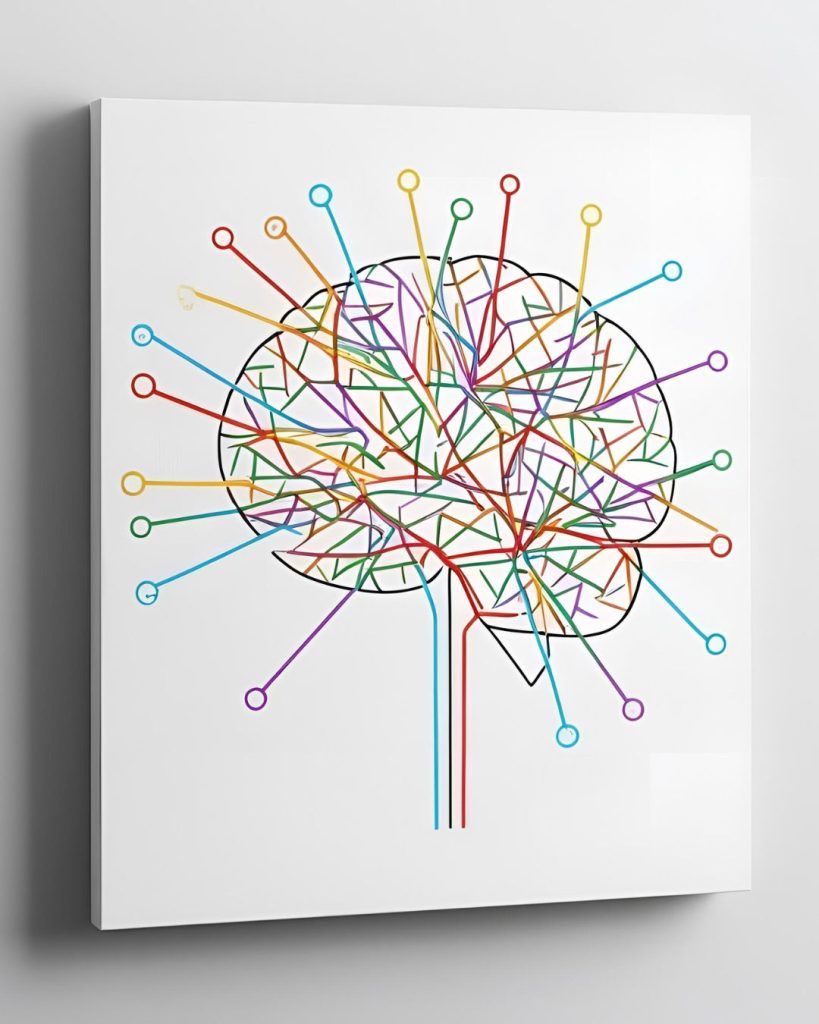
You become open to tackling challenges instead of avoiding them.
The brain and body work together to keep you out of the fight-or-flight mode so you can think without feeling impending urgency.
In stressful situations, you see situations as challenges rather than threats, and your body produces helpful hormones instead of harmful ones, like cortisol.
As a result, instead of using phrases like “I’m an idiot,” “I’m a loser,” “My life sucks,” “The world is out to get me,” and “Life stinks,” you think “Nothing ventured, nothing lost,” “no harm trying,” “let’s give it a shot and see where it goes.”
It’s what happens in your head!
Fixed and Growth Mindsets
What do we know about Fixed and Growth Mindsets from Carol Dweck’s research?
In the 1980s, Stanford psychologist Carol Dweck developed a theory about the significant role mindsets play in eventual success.
She says that the perception of limited intellectual ability stopped people with a fixed mindset from succeeding.
People with a growth mindset (i.e., those who believed in developing their abilities through hard work and practice) were more likely to succeed because they tried harder.
Over the years, she tested this theory repeatedly.
During one test, she gave a group of students a short training at the beginning of their academic year to teach them how to develop their intelligence over time and how to grow it. The message was clear – with effort, they could improve their performance.
To everyone’s surprise, students who underwent this course increased their grade point averages by 0.10 points. The number of students with a grade of D or F decreased by over 5 per cent as compared to the students who did not take this course.
Dweck didn’t stop at understanding mindsets on a surface level.
She also tested students with both – fixed and growth mindsets neurologically and saw how their brains responded to mistakes differently using electroencephalography to measure brain waves in the different regions of the brain.
She noticed that persons with a growth mindset had higher activity in the anterior cingulate cortex (ACC) and related brain areas associated with cognitive control of behaviour. This group focussed on solving problems and learning from their mistakes rather than ruminating and giving up.
Recent Research About Factors Impacting Healthy Mindsets
While Dweck’s idea of fixed vs. growth mindsets is helpful, real human thinking isn’t so black and white. A lot has happened since the 80s.
The latest research suggests that effective mindsets are more nuanced. Various factors form an effective mindset.
Positive personality traits and mindset
If you’re more curious or confident, you are likely to be more open to ideas. If so, you may be more prone to being excited about new projects rather than dreading them.
Similarly, if you’re harsh on yourself instead of being kind, you’re likely to take setbacks and failures as well enough to learn from them. If you’re compassionate with yourself, you’ll be able to pull yourself out of the ruts.
Influence of your company and environment
Depending on whether you’re from a low, middle or high-income family, you may learn to have a poor or good relationship with risk-taking.
If you have a supportive family or you live in a community, it can help you stay positive and motivated. Similarly, if you’ve grown up in a home where people’s moods dictated everything, you may get anxious even later in life at work when someone else is moody.
Past experiences and traumas
At the cost of repetition, you and I are the product of our experiences. Nurturing, bullying, dismissal, or encouragement—all influence how you think about yourself.
If you’ve learned that you’re not smart enough and that’s what you believe with all your heart, you’ll have trouble getting over failures and moving on.
Cultural influence
Your upbringing and societal culture play a huge role. Some societies are highly religious, many of them patriarchal, some consider working 90 hours/week as the norm while others consider 40 hours/week as the gold standard for a well-lived life.
Emotional intelligence and psychological factors
Your level of emotional intelligence, characterised by how well you know yourself, how well you’re able to regulate yourself and your emotions, how motivated you are, and your ability to empathise and socialise with others, directly influences your mindset. If you lack the right mindset, you won’t see clearly, and your decision-making ability will suffer.
Lifestyle and habits
Your daily habits, including what you eat and how active you are during the day, also result in the creation/secretion of specific hormones that influence your moods and mindset.
Mindset Traps That Keep You Stuck (And How to Escape Them)
Even when you’re trying to think positively, these common traps can hold you back:
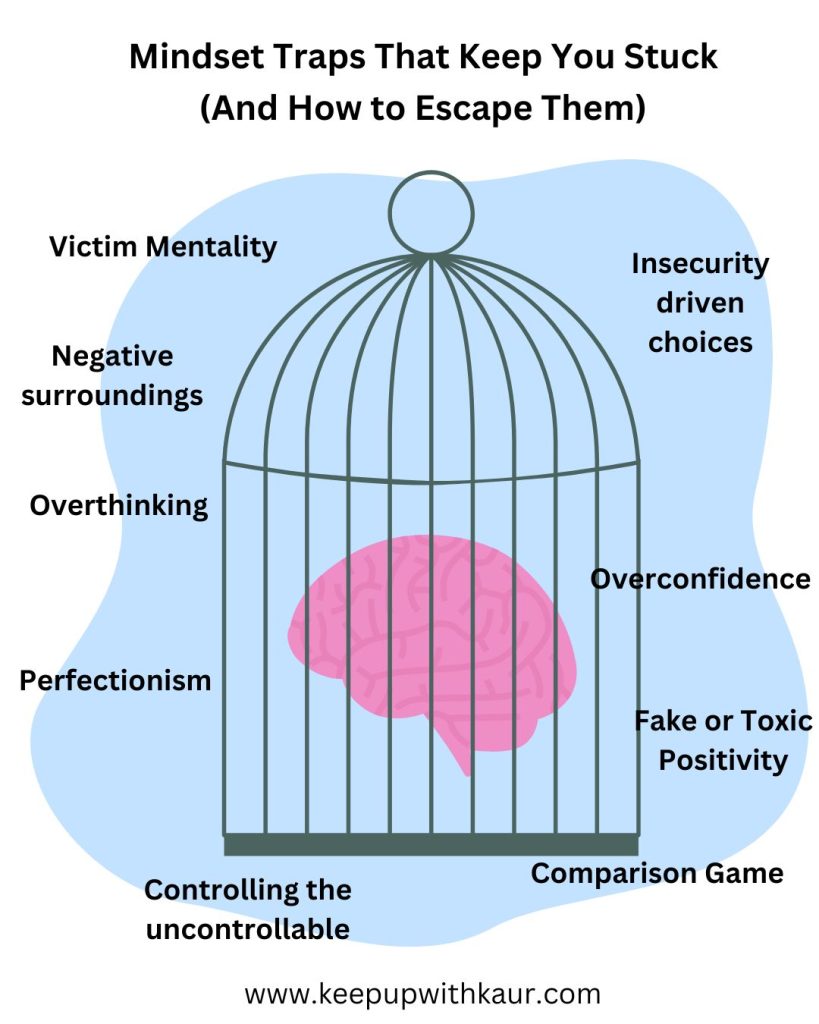
Black-and-White Thinking
Seeing everything as all-or-nothing (“If I’m not perfect, I’m a total failure”) blocks the thinking you need for growth. Mistakes and failures are a part of the process.
You can also hear Michael Jordan repeat in his interviews again, “I’ve failed over and over again—and that’s why I succeed”. His mindset is that of a winner and reframes his failures as paths to his successes.
Perfectionism
Believing anything less than flawless is unacceptable just leads to paralysis and procrastination. Even if it’s not perfect, it still counts.
Victim Mentality
Feeling helpless against your circumstances removes your power to change things and stops you from solving problems.
Let me clarify, I know we don’t start our lives at the same level. We’re all born and brought up in different circumstances. But because you’re reading this, this is your sign to stop pitying yourself and take control.
More about systematic improvement techniques to help you replace the victim mentality here.
Comparison Game
Measuring yourself against others instead of your progress creates unnecessary suffering and kills motivation.
Count your blessings and not your problems.
Insecurity driven choices
When you decide based on fear rather than what you actually want, you limit what’s possible for you. When thinking about your dream life, the barriers are only in your head.
Fake or Toxic Positivity
Forcing yourself to be positive while ignoring actual problems will prevent you from authentically processing your emotions and starting with realistic problem-solving.
The idea of positive thinking to shift mindsets is not to ignore the problems but to understand that there are solutions and pursue them.
If the problems are your own insecurities, which cause negative emotions repeatedly, then focus on resolving the problem rather than avoiding them.
Trust me, you will remain stuck in the pattern of negative thinking or a fixed/judger mindset unless you address what’s really going on.
Overthinking
Endless rumination without action just creates anxiety without progress.
Overconfidence
Overestimating your abilities without realistic assessment can lead to poor decisions and unnecessary risks.
Controlling the uncontrollable
You can’t control everything in your life and honestly, you being mad about it won’t change it.
You can’t change. It rains suddenly; the car stops functioning, employees don’t turn up, you fall sick, and food gets soiled. You ruminating over it or getting upset won’t change a thing.
What will help though is moving on and figuring out how to enjoy the weather, find a mechanic, finish the work or get help from someone else, take medicines and arrange fresh food.
Negative surroundings
Of course, the people and the environment are important and you should fix it if they’re holding you back.
But more importantly, you need to pay attention to the content you’re consuming. The algorithms of the technologies and social media platforms show us what we pay attention to, so it is easier to stay comfortably stuck in difficult circumstances.
How to Build a Better Mindset: Actionable steps
Let’s get down to business. Our brains are incredibly adaptable. The mindset you have today isn’t the one you’re stuck with forever.
If a 13-year-old could reframe her thoughts and change her reality in school, you have no excuses to make. I’m going to give you all the tools you need to rewire your brain so you don’t have to live a hard life. Let’s change your reality.
Two-Minute Miracles: Daily Gratitude Exercise
Instead of opening Instagram or YouTube first thing in the morning, reach out for a notebook and spend two minutes writing whatever you’re grateful for.
This isn’t just fad advice. Robert Emmons, a psychologist who has been studying people for 20 years, notes that rather than objective life circumstances, perception makes us happy. Conducting three tests, he proved that this one tiny habit can boost your happiness levels massively in just 10 weeks.
And all it takes is two minutes a day.
The Three-Pronged Approach to Life
Martin Seligman, who is also an expert psychologist in this field, divides life into three phases to help people deal with it. He claims that teaching people these three things about life can help them stay consistently happy and live more fulfilling lives.
Deal with the past
Instead of suppressing negative emotions, learn to embrace and express them. If you don’t deal with it today, it’ll stay there and infest your life for a long time.
Grounded in the Present
Focus on staying in the present moment when you’re doing life. Martin suggests staying mindful about the topics you pay attention to. If you’re working, pay attention to work. If you’re reading a book, eliminate distractions.
Optimism for the future
Finally, Martin suggests thinking about the future with hope and optimism. Learn to induce positive emotions by thinking optimistically about what’s yet to come.
Play The Mental Subtraction Game
Just close your eyes after reading this sentence and think about what would happen if you didn’t even have a job today? What if you had never met your partner? What if you had never recovered from the illness?
What if you didn’t have the means and the resources to research how to make yourself a better life? But here you are. You’re not one of those people who are sitting in their misery. You’re here gathering the tools to learn how to live happier.
The Effort Trophy: Celebrating Process Over Outcomes
The ultimate outcomes are not what lead to the growth of your brain and change in behaviour. It’s what you learn. It’s alright if you didn’t get the desired result; your efforts during the challenge still led to your growth. So you still won.
Stanford psychologist Carol Dweck’s revolutionary research shows that praising effort rather than results creates resilience and learning motivation.
If you learn to enjoy the process and focus on that, the results will follow. It’s only a matter of time.
The Power of “Yet”: Three Letters That Change Everything
One word, three letters, to remind you that you will not stay in the same place forever. You can move forward and you will.
This is how you can reframe to use the power of yet:
“I don’t know how to make more money”. You don’t know how to make money yet.
“I don’t know how to fix my relationship with my partner.” You don’t know how to fix your relationship yet.
“I don’t understand mathematics”. You don’t understand mathematics yet.
“I’m terrible at public speaking”. You’re not good at public speaking yet.
The Deliberate Challenge: Brain-Building Through Difficulty
If you stop using your brain, it’ll get rusty.
When was the last time you did something difficult on purpose? Can’t think of anything, let me give you some ideas:
- Learn a new language
- Study a new subject
- Learn how to play a new game, maybe chess
- Take an alternative route to home
- Pick up a puzzle game
The Five-Minute Reset: Ground Yourself In Reality
Your to-do list is getting longer. The meeting is not ending. Your inbox is exploding. The traffic is horrible. Yeah, all of this is stressful.
The technique of slow nasal breathing can activate the regions of the brain, which can reduce anxiety and induce calmness. It also results in improved cognition, so it helps you think better and clearer, allowing you to cope with stress and challenges better.
But before you surrender to the stress, set a timer for 5 minutes and simply follow your inhale and exhale breath through your nose. Thoughts will come and go and that’s okay. Come back to the present moment by noticing your breathing.
The Mono tasking Challenge: Single-Focus Power
If you think you’re a good multitasker, you’re lying to yourself. In fact, research from Stanford University shows that even trying to multitask can impair cognitive control. Instead of helping, it reduces efficiency by up to 40%.
Try this experiment: Choose one activity and do JUST that thing. Notice the details. Stay present. You’re not just getting more enjoyment; you’re literally strengthening your prefrontal cortex.
The Detective Method: Cognitive Reframing
Research shows that mindfulness strengthens your brain’s ability to change. Start with just five minutes daily of noticing your thoughts without judgment to spot limiting beliefs.
When you catch yourself thinking, “This always happens to me” or “I’ll never succeed”, gather evidence like a crime scene investigator.
The Observer Perspective: Self-Distancing Language
It’s hard to be objective about stressful situations when you’re the subject of those situations. This is where this technique comes into play. How would you advise your friend to pull herself out of the mess if it was her and not you?
This will help you look at the situation from an autobiographical perspective, and this approach has demonstrably reduced stress for people.
Studies also found that introspecting from an observer’s seat positively impacts your ability to regulate your thoughts, feelings, and behaviours under social stress, even for vulnerable individuals.
To put yourself in the observer’s seat, try speaking to yourself in the third person. Instead of asking, “Why am I feeling this way?”, ask “Why is [your name] feeling this way?”
Stop Wishing, Start Setting Goals
When you say “I want to get healthier,” you’re wishing for it but when you say that “I will walk 30 minutes every Monday, Wednesday, and Friday morning before work,” and “eat 200 calories less,” you’re setting real goals.
Setting goals instead of wishing for change will help you get into implementation mode to put everything into action.
The Happiness Equation: Relationships Trump Everything
A Harvard study that observed people for over 80 years throughout their lives, discovered that the quality of your relationships is a stronger predictor of happiness and mental well-being than wealth, fame, or achievement combined.
Oxytocin is way more powerful than you think.
Dr. Robert Waldinger, who pioneered this study, states that good relationships keep us happier and healthier.
People with a reliable support system showed lower rates of diabetes, arthritis, cognitive decline, and other chronic conditions. Their hypothesis is that close relationships act as
“stress regulators” — that help our bodies calm down and return to normalcy after stressful situations.
Having said all the above, of course, the time-tested and good-old exercising, getting good quality sleep, taking regular breaks, and spending time with friends and family are all essential for your brain health and well-being.
How to put the techniques into practice
Start small and with one technique.
I know I’ve given you a lot of information all at once, but you don’t need to implement all of them right away together. Just start small by spending 2 minutes on the gratitude journal every day and take it from there.
I’d love to hear which mindset-building technique you’re trying first! Drop a comment and let’s support each other on this brain-changing journey.
Do One Hard Thing Each Week
You aren’t stuck with your current mindset—it’s a garden you can cultivate with the right tools and consistent attention. The science proves it. The ball is in your court.
Building a growth mindset means gradually stepping outside of your comfort zone. Choose one minor challenge weekly that stretches you a bit.
Surround Yourself With Reminders
Put physical reminders of your desired mindset in your space. This could be inspirational quotes, vision boards, or regular coffee dates with growth-minded friends.
For me, changing my passwords to unlock my laptop and phone, and using certain quotes as wallpapers, works very well. Keep it simple and effective.
Create a Morning Power-Up
The reason I suggested you should do your gratitude journalling right in the morning is so it can set the tone for the rest of the day.
Be Kind to Yourself While Taking Action
There is no destination. There is no endgame here. The point of these exercises is to make your journey more enjoyable and set a clear path for yourself. Be deliberate in your actions and thoughts so you can be happier and live a more fulfilled life.
You’re chasing absolutely nothing. You’re living it. So be kind and create systems that combine self-compassion with specific next steps. For example, forgive yourself for mistakes while making a clear improvement plan.
Toxic positivity
Because we’ve talked about positivity so much here, I don’t want you to confuse it with avoiding emotions and challenging feelings to act like everything is okay when it’s not.
A good mindset isn’t blind positivity—it’s optimism that acknowledges challenges while believing in your ability to handle them.
Masking underlying issues won’t solve the problem. A positive mindset doesn’t mean you can close your eyes and pretend that the problems will go away. It means believing that life will improve and it will get better when you deal with the issue.
No matter how much you try to run away, the brain has a way of remembering episodic memories from significant moments that are – positive or negative. Deal with it in time.
The temporary solutions will only bide your time. Please don’t use positive thinking as a coping mechanism to ignore your problems. Use it to stay authentic and bold in the face of challenges. Set realistic expectations, make a plan, and track progress, consistently. The results will follow.
Follow The Mindset With Action: Where the Magic Happens

Mindset alone isn’t enough–it has to translate into consistent action.
Think of ways to complement your optimistic thinking and help you stay on track.
It provides the initial spark, but to change your life, you need to follow it up with action.
Design your environment to make good behaviours easier and unhelpful behaviours harder.
Whether it’s the people who hold you back, the environment that keeps you stuck or the social media algorithm that doesn’t let you catch a break .
Get away from the unhealthy reinforcing thoughts and behaviours and stay with the ones that remind you of everything you’re capable of.
Track your progress using both feelings and facts.
Pay attention not just to how you feel about your development but to concrete, measurable advances, no matter how small.
The action itself can change the mindset. Sometimes the best approach isn’t thinking your way into new actions, but acting your way into new thinking.
As psychologist William James noted, “Action and feeling go together; and by regulating the action, which is under more direct control of the will, we can indirectly regulate the feeling.”
Your Mindset, Your Choice: Small Shifts, Big Results
While mindset influences pretty much everything in your life, its power comes from conscious understanding and consistent practice.
- The life-changing potential of mindset isn’t triggered automatically–it requires a commitment to self-awareness, flexibility, and regular reinforcement through both thought and action.
- Your current mindset didn’t form overnight. It developed through years of experiences, messages, and interpretations. Changing it will also take patience and persistence.
- Start today by identifying one limiting belief you hold and consciously practising its opposite.
- Remember that mindset work isn’t about becoming perfect — but embracing continuous growth. Each small shift in perspective creates ripple effects across your life, relationships, and achievements.
- What one mindset shift would most transform your life right now? Share your thoughts in the comments—your experience might be exactly what someone else needs to hear.
- If you’re anything like me, you’ll probably steer away from your journey because you’ve got 50 other things to do. Help me help you stay consistent by sharing short notes directly in your email.
I have lived this and I continue to do so every single day. Even if you don’t believe me completely, give this a shot and I promise you won’t be sorry.


