The frequent advice to “think before you speak” makes it a cliché.
But that doesn’t diminish its importance – you don’t get a do-over with words. Words frame and cause real experiences for you and others you’re speaking to. They influence their thoughts and trigger emotional and physiological responses.
You may forget what you said in the heat of the moment, but the person who heard them will think about your harsh words for a long time.
The Power of Thoughtless Words
The Lasting Impact of Words
There is no option to ‘undo’ and ‘redo’ once the words are out of your mouth.
It doesn’t matter how pure your intentions are or how effective the solution you suggested was if you couldn’t explain it. It is carried forever.
Words Drive Solutions
If you cannot deliver your message to the right person correctly, it will lose its impact.
Your Words Position You In The Society
Mastering the art of thinking before speaking can help you position yourself as a leader in your society who can inspire and mobilise people to take action.
Instead, if you keep rambling, people will stop taking you seriously.
Words Shape Perception For Others
How information is perceived and understood depends on the various factors concerning the receptor.
Words play a critical role in weaving the stray threads of society’s fabric together.
Using words, you can express and connect with those you value. The depth of your words can strengthen or weaken your relationships.
Words Can Inspire or Injure
What you say can inspire, uplift, and heal someone or it can discourage and injure someone.
You are unaware of: anyone else’s circumstances, upbringing, biases, presumptions, current knowledge of the subject, or whether they are having a bad day, experiencing financial difficulties, or are ill.
You may have snapped at them only once, but their intense experience from that moment could add to their already troubled state of mind and stressors unknown to you.
How Does the Brain Respond: The Research Behind Interpretation of Words?
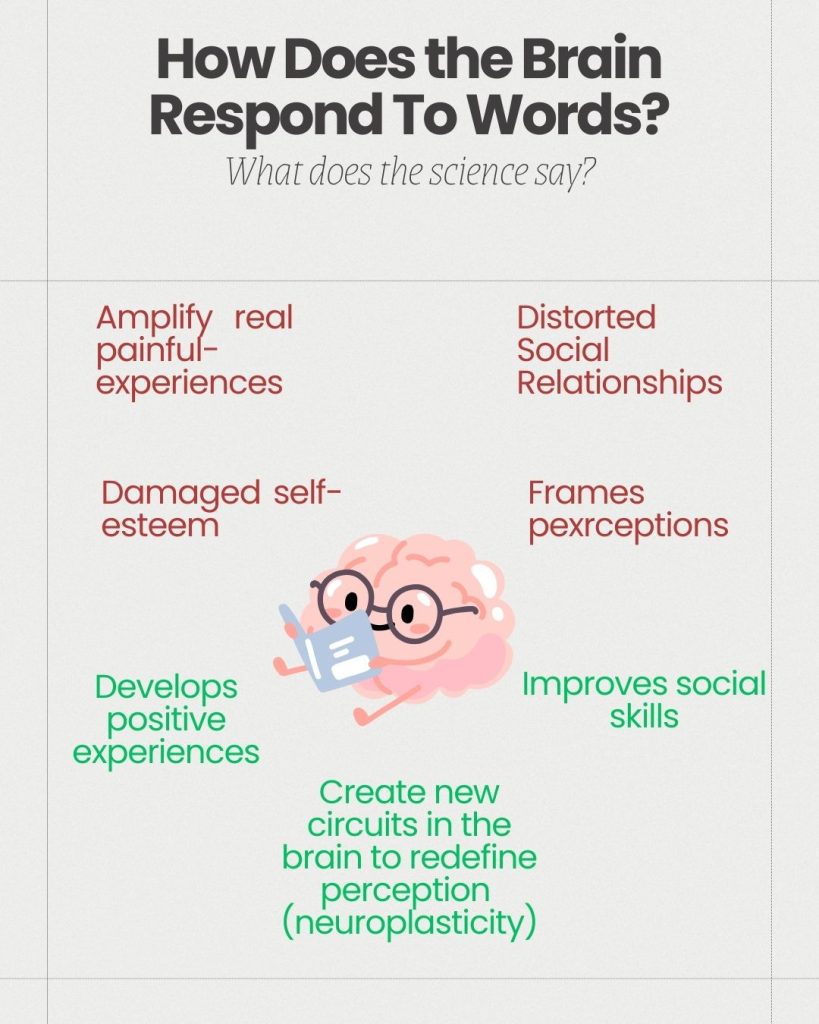
Words are not empty caskets. They carry weight and affect the actual experiences of the person hearing them.
Words Can Amplify or Reduce Pain
In a 2019 study, 17 people were given an electrical stimulus and told to rate the pain they experienced.
Thereafter, the researchers gave the participants the same electrical stimulus and also said positive (encouraging) or negative (discouraging) pain-related words to them.
Pain-Related Words Cause More Pain
They found that hearing pain-related and negative words activated a region of the brain that amplified the painful experience of the participants.
As a result, the participants in the research experienced greater pain than when they heard positive stimulus words.
Brain Uses Words To Frame Experiences
The related activity in the brain measured using the MRI scans also confirmed this.
Words Can Damage Self Esteem and Mental Distress
In a different study on the impact of verbal abuse on college kids, the researchers found verbal abuse resulted in increased anxiety, depressive symptoms, irritability, and reduced self-esteem in the participants of this research.
Mind you, this wasn’t a small group of students scientists tested with. This research included 5,000+ participants. And the results were consistent.
Words Can Distort Social Interactions
The study also noted that the students who suffered verbal abuse often responded to the abuse by using coping mechanisms that did not involve confrontation.
And as a general practice, they also preferred to text rather than call because in-person interactions terrified them.
Such experiences of harmful speech have a long-term impact on the receptor’s relationships.
Words Shape Perceptions
In another study, the scientists explored the impact of certain words on the receptors’ perception of what is being said.
Let me explain this with an example used in the study.
The scientists asked the participants to fill in the blanks with sentences using the words “cause” or “produce” in contexts of medical issues.
Most participants filled the blanks in the ‘cause sentences’ with negative consequences. However, they completed the ‘produce-sentences’ more neutrally.
The words you use to convey a message can influence the other person’s perception of the real situation, even if the facts are neutral.
That’s not all. There’s more.
Words Can Reshape the Structure of Your Brain
The words you use to talk to anyone, including yourself, can change the brain’s structure.
When you repeatedly use positive words and affirmations, something called neuroplasticity happens to the brain.
Simply put, you learn new concepts and the brain grows more.
The brain forms new pathways and connections, altering the wiring of its circuits. This changes the brain response and, as a result, your response and approach in situations.
We can considerably change who we are, who we perceive ourselves to be, what we can do and how we do things, even in adulthood.
Impact of the Words on the Speaker
Negative Self-talk Reinforces Limiting Beliefs
The words you use can make or break a person, including you, if you are the receptor.
And if you’re the speaker, your mean words spoil your mood and the environment, people around quickly learn to avoid you lest you ruin their mood.
Words Can Make You The Most Hated or Loved Person
The words you choose to communicate can break or make your relationships. Like I said, you don’t get a do-over when you make horrible remarks.
The same thing happens when you smile at someone, and they also respond with a warm smile. Sure, it made the other person feel good, so they smiled back. Didn’t that warm smile make you feel good as well?
No one wants to be the most hated person in the room or a red flag in their relationship. Choose your words carefully.
Why We Don’t Think Before Speaking (& How To Fix It?)
We’re wired to function on autopilot. You’d like to think you’re a rational human being, like Aristotle said but are you? If you’d like to read more about how the human brain is circuited to jump to conclusions and what you can do about it, read this.
It takes effort to slow down and think about the circumstances, the outcome you’re trying to achieve and an awareness of how to best achieve that outcome.
Let’s discuss what causes you to skip thinking before speaking.
Lack of Self-Awareness
You Can Only Control What You Recognise
In this article (The Ultimate Self-Awareness Guide: Emotional Intelligence at Workplace), we discussed that self-awareness means knowing your triggers and how they affect you and the surrounding others. Therefore, it can be internal or external.
You are a product of your readings, observations, interactions, upbringing, and the content you consume among other factors.
Knowledge is Power
You need to know yourself and the people you’re speaking to to tap into their feelings and alter your response based on that knowledge.
If you are unaware of your biases and presumptions, you won’t know where to check yourself before jumping to conclusions and communicating based on those.
Empathy Deficit
The ability to understand and share the feelings of others can help you apprehend how they will respond to your words.
If you can’t relate to the person hearing your words and understand their feelings, how can you visualise their response and decide the best way to communicate with them?
Poor Emotional Regulation Skills
Reacting vs. Responding
The nature and intensity of emotions experienced in similar emotions can be vastly different.
When emotions take over, rational thinking takes a back seat. The brain is busy dealing with insecurities and doesn’t have space to think about the best way to respond.
Functioning on Vulnerabilities
Certain situations can also trigger insecurities and vulnerabilities, which can cause you to become defensive.
As a result, you forget the real matter at hand and start focussing on creating a safe space to stop feeling vulnerable.
Solely Focusing on the Outcome & Not the Process
Remember the desired result, but also plan the steps and resources required.
You need to know all the players and then assign responsibilities to each of them to achieve the goal.
Lack of Social Skills
You may be self-aware, even be an empath, fully in charge of your emotional state and also know everyone’s triggers, strengths and weaknesses before speaking to them.
But is that enough if you lack basic social skills to convey your exceptional message?
No one can guarantee the success of great ideas if they are delivered poorly.
Actionable Strategies to Make Your Words Count
You’re reading this because you want to be a leader, an understanding partner, a comforting parent or a good child to your parents. These desires will not be fulfilled automatically because you intended.
You will need to deliberate action directed towards the following strategies for implementation.
Self-Awareness: Who Are You?
We spoke about emotional regulation above.
Challenge Your Biases
Your schemas and triggers can lead you to make harmful assumptions about situations and act on those assumptions instead of facts. It’s like wearing black sunglasses. Everything seems darker when you wear them.
Work on Triggers
- Make space for your emotions.
- Recognise your triggers.
- Hit pause when triggered.
- Are you interpreting the facts correctly or is your judgement influenced by your triggers?
- Think of the responses.
- Determine the short-term consequences and long-term consequences of your responses.
- Consider the response that will best serve your problem.
If you’d like to understand whether you need to self-regulate and how to do it, read this (How To Self-Regulate Like a Pro: Emotional Intelligence 101).
Active Listening
Hearing is the physical process of perceiving sound. It’s an involuntary process. You can hear a car’s horn from afar.
Listening involves understanding what is being said. This is a deliberate process where you assign meaning to words and make sense of them. Notice the body language and take cues from the tone of the speaker.
To listen actively:
- Ditch the distractions for the duration of the conversation and show respect to the speaker.
- Listen with your mind and body, i.e., use body language (nodding) to convey agreement and straight back to show interest.
- Ask questions and seek clarifications wherever necessary.
- Notice your emotional response to the situation.
- Listen to all the parties, including the opposing (interested) and third (uninterested) parties.
- Focus more on the information and the problem to be solved and take cues from others’ body language.
Pause Before Responding
Take a Moment To Process Before Speaking
Listen to the speaker patiently. Refrain from interrupting the speaker and wait for them to finish speaking before making judgements.
Don’t be Afraid to Postpone the Response
And if you’re not in the headspace or don’t have the bandwidth to listen, postpone the discussion or at least your response.
This is the least you can do to show respect to someone spending their time and energy communicating with you.
Respond Based on The Environment
Different Settings Require Different Tones and Words
Are you at work? Are you in a meeting with the clients? Are you attending a family function? Depending on where you are, you must choose your words, alter your tone and mind your body language.
Tailor Your Message Based on Context
If you let your anger lose this instant, how will the environment change in the room? Are you alright with that, or should you postpone your response?
Use Constructive Language
Use Encouraging Words and Tone
There are many ways to say the same thing.
A mistake in an assignment may seem like a fixable bump in the road to one person. It may feel like the end of the world to another.
Consider this.
Your junior sent the wrong version of the document out to the client. Or your kid spilt her milk on your important papers. Of course, you’ll probably be very angry in both situations.
But you still have a choice – to express that anger by screaming at the junior/kid or first deal with your anger, learn where they’re coming from and encourage them to do better next time.

Make, Don’t Break People
You will achieve the desired result of ensuring that they don’t repeat the mistake out of fear, but you could damage their self-esteem.
Also, if you think screaming at someone else will make you feel better, why don’t you try that too and see how long it takes to redeem your sense of calm?
If you choose the latter approach to deal with the situation, you’ll not only give them fish for this time but also teach them how to fish.
It’s a win-win.
Consider the Impact: Inspire or Injure?
Before you respond, consider the impact of your words on the person hearing them, and the others who work or spend time with them.
Align your message with your intent.
Are you inspiring, teaching, healing, supporting, and encouraging someone? Or are you hurting, discouraging, or injuring someone?
Develop Emotional Intelligence
Emotional intelligence is a tool for relationship management. It is the ability to understand your emotions and manage them, and to apprehend how your emotional state impacts others around you.
Power of Self-Regulation & Empathy In Speech
It helps you become a sound decision-maker, and a trained conflict manager, build better teams, invest in better relationships and be a true leader.
Emotionally Intelligent Leaders Communicate Better
I don’t mean this metaphorically, there are studies to show that teams that function under emotionally intelligent managers are not only happier, but they also perform better in terms of productivity and profitability.
We consider it so important that we’ve covered it at length in multiple posts on the blog. If you’d like to get a head start on learning to be emotionally intelligent, you can read this.
Rules for Thoughtful Speech: A Checklist
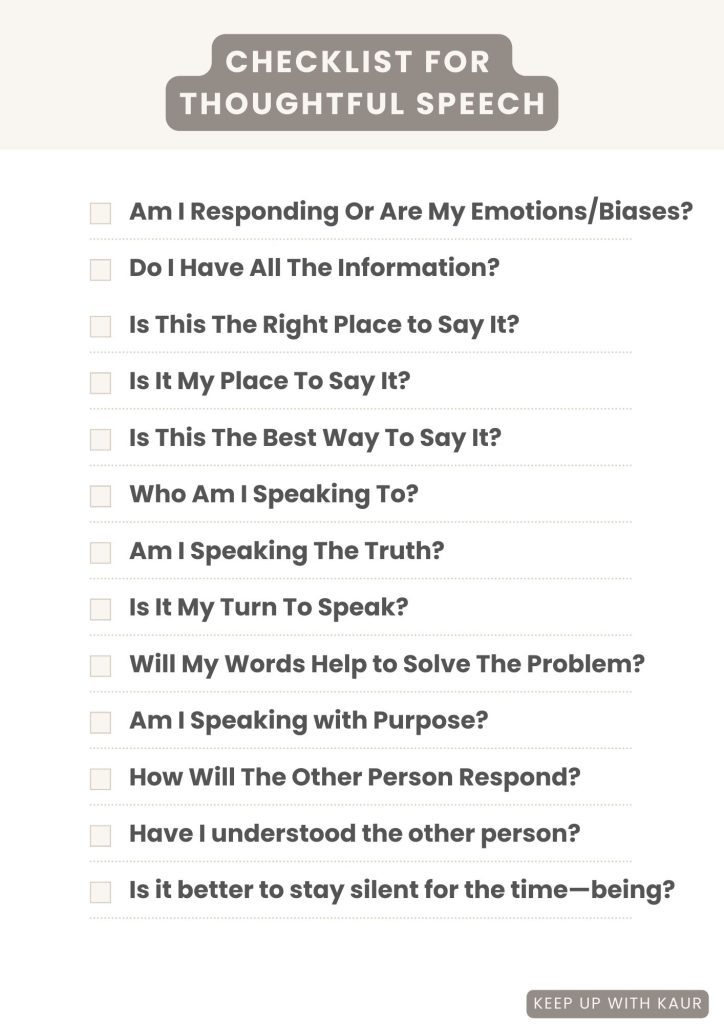
It doesn’t matter who you’re talking to and what you’re saying, these are a few rules you should learn to incorporate. Before you utter any words, see if they’re checking the boxes.
- Have you correctly understood what the other person is saying?
- Who are you speaking to?
- Are you speaking the truth?
- What is the purpose of your words? Are your words conveying that purpose?
- Is it better to stay silent for the time—being to avoid escalation or encourage deeper thought?
- Are you being respectful and kind while speaking?
- Have you considered the words’ impact on the receptor and the surrounding others?
- Is it relevant to the discussion?
- Is it your place to say it?
- Is it your turn to speak now?
- Will it help achieve the goal and solve the problem?
Practical Strategies To Think Before You Speak – A Bullet Guide
Here is a quick summary of practical strategies suggested:
1. Pick up an instance when your words:
- Resulted in a conflict;
- Negatively impacted the environment; or
- Instilled negative emotions for someone.
2. How could you frame it better by applying rules of thoughtful speaking?
3. Why did you lose control over yourself in that moment?
4. Apply the rules and test your strategy.
5. Do you need to apologise and clarify to avoid misunderstanding?
Also, a quick checklist for you to use as a phone wallpaper, put on your bedside table, or your desk.
Or gift it to someone who needs it. 🙂
Final Thoughts
Your words make someone else’s reality.
- Rehearse the mantra in your head particularly if it’s an important message.
- Even a harsh message, with empathy in the tone and the speaker’s body language, can be delivered softly to the person hearing it.
- Thinking about the response doesn’t mean it’s less genuine.
- Such reflection on your words strengthens them, as each is spoken thoughtfully and purposefully.
- Especially in the digital age where people sit behind screens and spew poisonous words at others thinking that no one will catch them.
- If you’ve made a mistake and used words that conveyed a confusing reading, don’t hesitate to acknowledge that, offer a sincere apology and clarify your intention to the receptor.


